11/02/2023

COVID-19: Singapore, Hong Kong, Taiwan & China 2023

Update: 7 Oct 2023 Worldometer COVID-19 Coronavirus Pandemic


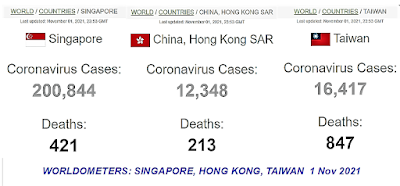
WORLDOMETERS: SINGAPORE, HONG KONG, TAIWAN & CHINA 6 JAN 2023


Updated 7 Oct 2023: COVID-19: Tracking new variants

New variants of SARS-CoV-2, the virus that causes COVID-19, will continue to occur. CDC coordinates collaborative partnerships which continue to fuel the largest viral genomic sequencing effort to date. The Omicron variant, which emerged in November 2021, has many lineages. New lineages continue to emerge and spread in the United States and globally.

Viruses constantly change through mutation and sometimes these mutations result in a new variant of the virus. Some changes and mutations allow the virus to spread more easily or make it resistant to treatments or vaccines. As the virus spreads, it may change and become harder to stop.

Understanding the Variants:
  • How Variants Work - If you think about a virus like a tree growing and branching out, each branch on the tree is slightly different than the others. By comparing the branches, scientists can label them according to the differences. These small differences, or variants, have been studied and identified since the beginning of the pandemic. Some variations allow the virus to spread more easily or make it resistant to treatments or vaccines. Those variants must be monitored more carefully.
  • How the Virus May Change - As a virus spreads, it has a chance to change. As genetic changes happen over time, the virus that causes COVID-19 begins to form genetic lineages. The SARS-CoV-2 virus can be mapped out similar to a family tree. All lineages have names to help scientists talk about them. SARS-CoV-2 lineages with similar characteristics may affect how fast the virus spreads, the severity of illness it causes, or the effectiveness of treatments against it; some of these may be classified by the World Health Organization (WHO) or the U.S. SARS-CoV-2 Interagency Group (SIG). All lineages currently circulating are classified as part of the Omicron variant.

Singapore experiencing new COVID-19 wave, more people expected to fall sick in coming weeks

Singapore is experiencing another COVID-19 infection wave, with more people expected to fall sick and be hospitalised in the coming weeks, Health Minister Ong Ye Kung said on Friday (Oct 6). However, he added that there are no plans to impose any social restrictions, as with the last wave which occurred from March to April.

Speaking at the official opening of the Stepping Stones Rehabilitation Centre and Serenity Centre at the Institute of Mental Health, Mr Ong revealed that the estimated daily cases has risen from about 1,000 three weeks ago to 2,000 for the past two weeks. The spate of cases is driven by mostly two variants - the EG.5 and its sub-lineage HK.3 - both of which are descendants of the XBB Omicron variant. "Together, they now account for over 75 per cent of our daily cases," Mr Ong said.

During the peak in April, the number of infections rose to about 4,000 cases a day. "We will treat this as an endemic disease, which is in line with our strategy, and we will live with it," he said. "After all, there has been no evidence to suggest that the new variants are more likely to lead to severe illnesses compared to previous variants.

related:


Number of Covid-19 infections in Singapore more than doubled in Sept 17-23 week

There was a spike in the number of Covid-19 infections here in the week of Sept 17 to 23. The 14,843 people diagnosed with the disease are more than double those in the previous week, when 6,401 cases were recorded. 
In the previous 10 weeks, between July 9 and Sept 16, the number of infections each week ranged from 3,485 to 7,045.

Singapore no longer requires reporting of Covid-19 cases, so these numbers generally reflect those who sought medical care. The Ministry of Health (MOH) said it is monitoring the situation, but does not think there is a need to worry as the number of people infected “is currently low compared to previous waves”. “The average daily new Covid-19 hospitalisations and average daily new ICU (intensive care unit) cases have also remained low,” it said about the current spike in cases on its Covid-19 website.

The peak number of infections this year was 28,410 a week at the end of March. That week, 159 people were hospitalised, a slight increase over the 139 in the previous week; and seven needed to be admitted to intensive care, up from six in the previous week. However, hospitalisation and the need for intensive care usually lag infections. The infection peak at the end of March had led to a higher number of hospitalisations and admissions to the ICU in April.


Covid-19 is no longer global health emergency - WHO
Covid-19 is here to stay even if it no longer represents an emergency, the agency said. PHOTO: REUTERS

Covid-19 no longer represents a global health emergency, the World Health Organisation (WHO) said on Friday, a major step towards the end of the pandemic that has killed millions of people, disrupted the global economy and ravaged communities.

The WHO’s emergency committee met on Thursday and recommended the UN agency declare an end to the public health emergency of international concern, which has been in place for more than three years. “It’s therefore with great hope that I declare Covid-19 over as a global health emergency,” said WHO director-general Tedros Adhanom Ghebreyesus, adding that the end of the emergency did not mean Covid-19 was over as a global health threat.

The WHO’s emergency committee first declared that Covid-19 represented its highest level of alert on Jan 30, 2020. The status helps focus international attention on a health threat, as well as bolstering collaboration on vaccines and treatments. Lifting it is a sign of the progress the world has made in these areas, but Covid-19 is here to stay, the WHO said. “Covid has changed the world, and it has changed us. And that’s the way it should be. If we go back to how things were before Covid-19, we will have failed to learn our lessons, and failed our future generations,” said Dr Tedros.

World Health Organisation WHO

In Singapore, from 3 January 2020 to 4:16pm CEST, 3 May 2023, there have been 2,368,597 confirmed cases of COVID-19 with 1,722 deaths, reported to WHO. As of 27 March 2023, a total of 14,904,028 vaccine doses have been administered.


SINGAPORE EXIT ACUTE PHASE OF PANDEMIC

In line with the transition to DORSCON Green, key COVID-19 Statistics will be consolidated on the COVID-19 Statistics page and updated on a weekly basis from 13 February 2023, to align with reporting for other endemic infectious diseases in the Weekly Infectious Diseases Bulletin. Singapore’s COVID-19 situation has remained stable in recent months. This is despite increased travel over the year-end holiday period, the Northern Hemisphere winter season and China’s shift away from a Zero-COVID policy. We are therefore able to step down the remaining few COVID-19 measures, and establish an endemic COVID-19 new norm. That said, the virus will continue to evolve, and we should expect new infection waves from time to time, and over and over.

An endemic COVID-19 new normal will therefore not be static, and we will adjust our measures when necessary. But unless it is a very dangerous and virulent variant, we should be able to manage these subsequent waves with an appropriate level of measures that does not deviate significantly from the new norm, and continue to live our lives normally. Globally, the number of new COVID-19 cases has been declining since late December 2022, and viral variants of higher severity have not emerged. Infection waves in the Northern Hemisphere and in China are rapidly subsiding. Locally, there was no significant increase in the number of imported cases. The World Health Organization has recently acknowledged that the pandemic is nearing a turning point, signaling that the global COVID-19 emergency may be ending soon. Amidst the improving international situation, several countries have recently eased COVID-19 measures or signaled further steps towards treating COVID-19 as an endemic disease.

Our population has developed a high level of hybrid immunity and is well protected from severe COVID-19. Around 80% of our population have achieved minimum protection, and around half are up to date with their vaccinations. Many have also recovered from infection during previous COVID-19 waves. With this, the risk of COVID-19 infections leading to severe illness or death has become very low, comparable to other endemic respiratory diseases, such as influenza or pneumococcal infections. Over January 2023, the daily number of COVID-19 related hospitalisations stayed below 100, and daily COVID-19 related patients in the Intensive Care Unit (ICU) remained in the single digits. The Disease Outbreak Response System Condition (DORSCON) framework gives an indication of the current disease situation. With the stable global and local situation, the mild nature of the disease especially among vaccinated individuals, and the minimal disruption posed to our healthcare capacity and daily lives, we will adjust the current DORSCON level from Yellow to Green from 13 February 2023. From 13 February 2023, we will step down the following community measures:
  • Mask-wearing
  • Revised Health Advisory
  • Public Health Measures for Migrant Workers Living in Dormitories
  • Stepping Down TraceTogether (TT) and SafeEntry (SE)
  • Regularising COVID-19 Financing Schemes
  • Stepping Down Border Measures
  • Vaccination as our Primary Defence in Living With COVID-19
  • Vaccination Requirements for Permanent Residence, Long Term Passes and Work Passes Remain in Place
  • Standing Down of the Multi-Ministry Taskforce
  • Staying Vigilant
  • Reflecting on Our Fight Against COVID-19

Through the frontliners' eyes, what went well and what fell short in Singapore's COVID-19 fight
Infectious disease expert Leo Yee Sin said Singapore has reached a significant milestone of ‘normalcy’ in its fight against COVID-19 with remarkable achievement, and it is now time to reflect on areas of deficiency and learn from the lessons to further strengthen Singapore’s capability to take on emerging infections. (Illustration: TODAY/Anam Musta'ein)

After three years battling COVID-19, Singapore this week exited the acute stage of the pandemic. Singapore's efforts at battling the unprecedented pandemic has won international applause. Experts said one area Singapore did well in is its rapid procurement of COVID-19 vaccines and test kits. But there were also missteps in the handling of the pandemic. One of them was the Government’s response to the outbreak in migrant worker dormitories.

Singapore has come full circle since its first COVID-19 case surfaced in January 2020, from a lockdown, shuttered borders, ever-changing permitted group sizes, mass vaccination programme, to a mask-lite existence in recent days. Along the way, its efforts at battling the unprecedented pandemic has also won international plaudits.

AREAS WHERE SINGAPORE DID WELL:
  • Procurement of vaccines and test kits
  • Science-based approach
  • Whole-of-Government response and communication
AREAS WHERE SINGAPORE FELL SHORT:
  • Handling of outbreak in migrant worker dormitories
  • Well-being of healthcare workers

Will Dorscon Green Spell The End of Lee Hsien Loong’s Term as Prime Minister?

“I had expressed the hope that I would be able to hand over by the time I celebrate my 70th birthday. But I do not determine the path of the Covid-19 pandemic, and it will also depend on how events unfold. And all I can say is, I will see this through. And I’ll hand over in good shape as soon as possible to the next team, and into good hands.”

In July 2020, Prime Minister Lee Hsien Loong said that he hopes to step down when he turns 70. That came last year – he will turn 71 in 2023. However, Singapore was not out of the woods with regards to the Covid-19 pandemic. The Covid-19 alert was sounded in Singapore in Feb 2020, when Dorscon Orange was announced. Yesterday, it was downgraded to green to inform the Singaporean public that all restrictions have been lifted and life goes back to normal.

Finance Minister and Deputy Prime Minister Lawrence Wong has already been touted as the PM-in-waiting. So with Covid out of the way and a potential new heir to the throne, are PM Lee’s days as prime minister numbered?


No masks on public transport, free vaccines: 6 things you need to know as S’pore lifts Covid-19 rules

From Feb 13, commuters will no longer have to wear masks when taking public transport as community regulations are progressively lifted.

This was among the changes to measures that the multi-ministry task force tackling Covid-19 announced on Thursday.

This comes more than three years after the first Covid-19 case was reported in Singapore on Jan 23, 2020. Here’s what you need to know about the changes:
  • No masks required on public transport
  • Covid-19 vaccines remain free
  • Treatment and testing no longer fully subsidised from April 1
  • TraceTogether and SafeEntry no longer required
  • Unvaccinated travellers entering S’pore do not need pre-departure test
  • Migrant workers no longer need to apply for pass to enter popular places

Where is Singapore headed in its new post-COVID-19 norm?

Three years and two days ago, Singapore raised its alert level for the COVID-19 outbreak to code orange. Hours later, long queues started appearing at supermarkets across the island, with residents stocking up on necessities in case of a lockdown.

That lockdown, or circuit breaker, came two months later on Apr 3, 2020. Most workplaces were closed and schools went into home-based learning mode. Residents were advised to remain home and avoid socialising with others. Masks became mandatory soon after. On Thursday (Feb 9), the COVID-19 multi-ministry task force held its last press conference, announcing an end to three years of restrictions that aimed first to contain the COVID-19 outbreak and then to mitigate its impact.

Singapore will move to DORSCON green on Monday, the lowest alert level since the pandemic started. During the last three years, our lives were restricted and more than 1,700 people died from COVID-19, but both the social and health impacts were much worse in most comparable countries. What, then, are the lessons for future health crises? The first striking point is how ready Singaporeans were to take the steps that medical experts and the Government recommended to prevent spread. Mask-wearing in Singapore was not as common before COVID-19 as it was in Japan.


What does endemic mean when it comes to COVID?

First the coronavirus was an epidemic, then it became a pandemic, and now we're starting to hear over and over again that it's on its way to becoming endemic. That means COVID will forever be part of our lives in some form, like how the Spanish flu of 1918 morphed over time into the common flus of today.

As we grapple with Delta rage, it's helpful to understand what endemic means when it comes to COVID both in terms of what we do in the present and what our day-to-day will look like in the future. For starters, even if COVID will eventually become endemic, it doesn't mean we should give up trying to contain the virus, public health experts have said. And if more of us get vaccinated now, and maybe one day annually, getting COVID may mean a few days of discomfort and then bouncing back to normal until we do it all again the following year. "There will be a time in the future when life is like it was two years ago: You run up to someone, give them a hug, get an infection, go through half a box of tissues, and move on with your life," Emory University researcher Jennie Lavine told The Atlantic. "That’s where we’re headed, but we’re not there yet."

What does endemic mean? When a disease spikes suddenly in a certain area, that's an epidemic. When that disease spreads uncontrollably into multiple countries, that's a pandemic. When it burrows so deep that it constantly hums along, albeit at controlled, predictable levels, that means it's endemic.


We may be entering Covid’s least predictable year yet

The Covid-19 outbreak is officially three years old on 30 Jan 2023, which marks the moment in 2020 when the World Health Organization declared the respiratory disease a public health emergency of international concern. But this month’s anniversary offers little to celebrate in the wake of China’s chaotic and abrupt lurch from zero-Covid to full-Covid.

Beijing has dramatically reduced testing, junked contact tracing and is scrapping most quarantine requirements; some regions now permit infected people with mild or no symptoms to go to work. The pandemic virus is thus free to circulate unobserved in a sixth of the world’s population — just as the rest of the globe is clamouring for normality. As the third year of the outbreak closes amid reports of overflowing hospitals in China and fresh restrictions on air travellers, and with the Chinese new year holiday fast approaching, the pandemic seems somehow more familiar and less predictable than ever.

China is right to abandon its inhumane and unworkable zero-Covid policy, but it has done so from a position of relative weakness. A headline 90 per cent vaccination rate masks the reality that its homegrown vaccines are less effective than the mRNA ones used widely elsewhere, and that around 30 per cent of the country’s 260mn over-60s (and more than half of its over-80s) have not received a third dose. Those factors have led to hair-raising projections, ranging from 1mn deaths this year to 1.7mn deaths by the end of April — and has prompted the EU to offer free vaccines to China.


China reopens borders in final farewell to zero-COVID

Travellers began streaming into mainland China by air, land and sea on Sunday (Jan 8), many eager for long-awaited reunions, as Beijing opened borders that have been all but shut since the start of the COVID-19 pandemic.

After three years, mainland China opened sea and land crossings with Hong Kong and ended a requirement for incoming travellers to quarantine, dismantling a final pillar of a zero-COVID policy that had shielded China's people from the virus but also cut them off from the rest of the world.

China's easing over the past month of one of the world's tightest COVID-19 regimes followed historic protests against a policy that included frequent testing, curbs on movement and mass lockdowns that heavily damaged the second-biggest economy.


Singapore confirms first case of Wuhan virus on 23 Jan 2020
Guests at Shangri-La's Rasa Sentosa Resort & Spa yesterday. A man from China who is the first to test positive for the Wuhan virus in Singapore had stayed at the resort, said the Health Ministry. ST PHOTO: TIMOTHY DAVID

A China national has tested positive for the Wuhan virus in Singapore, with another likely to have the virus.

The 66-year-old man, a Wuhan resident, arrived in Singapore with nine travelling companions on Monday (Jan 20), and stayed at Shangri-La's Rasa Sentosa resort, the Ministry of Health said at a briefing on Thursday night (23 Jan 2020).

All the rooms at the hotel where the man and his travelling companions stayed in have been sanitised and sealed off.


Singapore reports first deaths from COVID-19

Two patients died from Covid-19 on Saturday morning (March 21) due to complications, the first deaths the Republic has seen.

A 75-year-old Singaporean woman with a history of chronic heart disease and hypertension died at 7.52am.

She had been admitted to the National Centre for Infectious Diseases (NCID) on Feb 23 for pneumonia and was confirmed to have Covid-19 the same day.

read more


REUTERS COVID-19 TRACKER: SINGAPORE

Average number of new infections reported in Singapore each day reaches new high: Now reporting more than 2,300 daily.

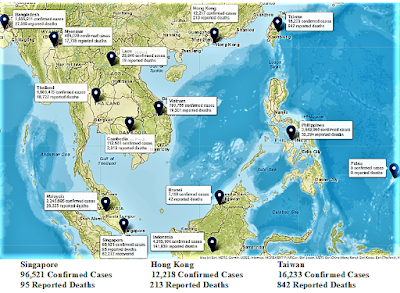
COVID-19 infections in Singapore are at their peak — the highest daily average reported — now at 2,397 new infections reported each day. There have been 106,318 infections and 121 coronavirus-related deaths reported in the country since the pandemic began.

Singapore has administered at least 9,486,020 doses of COVID vaccines so far. Assuming every person needs 2 doses, that’s enough to have vaccinated about 83.2% of the country’s population.


REUTERS COVID-19 TRACKER: HONG KONG

Hong Kong is reporting 4 new infections on average each day, 3% of the peak — the highest daily average reported on July 30.

There have been 12,238 infections and 213 coronavirus-related deaths reported in the country since the pandemic began.

Hong Kong has administered at least 8,745,399 doses of COVID vaccines so far. Assuming every person needs 2 doses, that’s enough to have vaccinated about 58.2% of the country’s population.


REUTERS COVID-19 TRACKER: TAIWAN

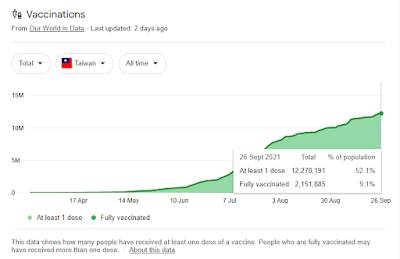
COVID-19 infections are decreasing in Taiwan, with 7 new infections reported on average each day. That’s 2% of the peak — the highest daily average reported on May 30.

There have been 16,262 infections and 844 coronavirus-related deaths reported in the country since the pandemic began.

As COVID-19 infections began to be reported around the world, many countries responded by shutting down places like schools, workplaces and international borders in order to contain the spread of the virus.


REUTERS COVID-19 TRACKER: MAINLAND CHINA

COVID-19 infections are decreasing in Mainland China, with 29 new infections reported on average each day. That’s 1% of the peak — the highest daily average reported on February 13.

There have been 96,284 infections and 4,636 coronavirus-related deaths reported in the country since the pandemic began.

Mainland China has administered at least 2,214,564,000 doses of COVID vaccines so far. Assuming every person needs 2 doses, that’s enough to have vaccinated about 79.2% of the country’s population.


COVID-19: Singapore, Hong Kong, Taiwan & China

The COVID-19 pandemic is one of the major topics at this year's G-20 summit. Some countries in Asia have decided that their earlier strategy of zero COVID is futile and that they must learn to live with the virus. 
In Singapore, that shift has ushered in a surge of coronavirus infections.

Singapore has one of the world's highest vaccination rates at 82%, yet cases of COVID-19 are skyrocketing from just double digits in August to well over 3,000 cases a day now. Infectious disease physician Dale Fisher of the National University Hospital says Singapore is letting nature take its course.

Singapore's health experts say exiting the pandemic will mean a carefully calibrated lifting of lids and laying them back on again as needed. Fisher says it may take another year or two. Meanwhile, he says don't expect a Singapore version of the U.K.'s Freedom Day, where almost all COVID-19 restrictions were lifted.


related:
Singapore urges calm after panic buying hits supermarkets
Singapore reports its first cases of local COVID-19 transmission
Singapore confirms cases of COVID-19 Virus

10/02/2023

How to Use Your Partner’s Pheromones to Improve Your Sleep


Beauty sleep is more than just a myth. Getting a good quality night sleep can improve your overall physical and mental health. But for some people, sleeping well is not that simple. Countless studies have been made on the subject and came up with various ways to improve your quality of sleep, all coming up with tips that will help you get proper rest. One such study that was recently conducted at the University of British Columbia suggests that one way to sleep better is to smell the pheromones of your romantic partner. In fact, participants of the study were exposed to their partner’s scent and ended up sleeping better, even if the partners weren’t physically there when they slept!

No need for sleeping pills - One of the chemicals that regulate our sleep is melatonin, and when people have trouble sleeping they often take a melatonin supplement to help them sleep. Those supplements usually improve your sleeping quality by two percent. According to the study, sleeping with a partner’s scent (even if it’s just on the pillow next to you or wearing one of their shirts as pajamas) can improve your sleep quality just as well.

Testing it out - The research was conducted on a group of 155 subjects. At first, the subjects’ partners were given a shirt they had to wear for 24 hours. During that time, they were not allowed to use deodorant, smoke, or eat food that has an effect on their body odor. Then, each subject was given their partner’s shirt along with a different shirt that was either clean or worn by a stranger. Each shirt was then used as a pillowcase for the subject to sleep on, switching back and forth between the two. Each night of sleep was followed by a survey the participants filled out when they woke up, and the movements they make in their sleep were monitored by an actigraphy machine. Unsurprisingly, when sleeping on the pillowcase that had their partner’s pheromones on it, they moved less and felt more rested the next day.


Pheromones and their effect on women’s mood and sexuality

Pheromones are substances which are secreted to the outside by an individual and received by a second individual of the same species. Many examples exist in animals but their role in humans remains uncertain since adults have no functioning vomeronasal organ, which processes pheromone signals in animals. Yet pheromones can be detected by the olfactory system although humans under develop and underrate their smelling sense.

Pheromones may be present in all bodily secretions but most attention has been geared toward axillary sweat which contains the odorous 16-androstenes. One of these steroidal compounds, androstadienone, is present at much higher concentrations in male sweat and can be detected by women, albeit with wide variation in sensitivity. Upper-lip application of a pharmacological dose of androstadienonein women results in improved mood and heightened focus - particularly to capture emotional information. A positive mood is known to facilitate women’s sexual response, and increased focus improves sexual satisfaction. Indeed, some studies showed a beneficial effect of androstadienone on sexual desire and arousal. However, these effects were dependent on the context of the experiment, for example, on the presence of a male attendant.

Pheromones may also play a role in mate selection which is “disassortative” regarding the human leukocyte antigen (HLA)-genotype. Preliminary evidence suggests that exposure to androstadienone in women promotes attractiveness ratings of potential mates. In conclusion, some data indicate that 16-androstene pheromones, in particular androstadienone, play a beneficial role in women’s mood, focus and sexual response, and perhaps also in mate selection.


Breathing Can Affect the Way You Sleep

Let’s say you do everything in your power to ensure a good night’s sleep. You make sure the temperature in your room is perfect, you avoid screens before bedtime, you invest in natural sleep supplements, you’ve done it all. And yet, somehow, you find yourself waking up throughout the night or wake up feeling like you haven’t slept at all. Don’t give up hope quite yet – the answer may be in the way you’re breathing. So, how can you breathe for a better night’s sleep? Allow us to explain!

First off, you must understand the link between breath and sleep. You can’t expect to get a deep, restful sleep if you’re having trouble breathing at night. Studies have shown that patients who have been diagnosed with sleep apnea have a higher prevalence of insomnia. On the other hand, other studies revealed that 90% of all awakenings were led by sleep breathing events, despite no earlier diagnosed symptoms.

Nasal breathing is one way to ensure better sleep. Other than the fact that breathing through your nose filters bacteria and viruses and can support immune health, breathing through your nose allows you to retain more oxygen. You can get more oxygen with fewer breaths, as opposed to breathing through your mouth, which causes your tongue to fall back, blocking the airway. Individuals who breathe through their mouths are more commonly experience sleep disorders. But how do you make sure you’re sleeping through your nose if you’re asleep? Great question! There is a method called “mouth taping,” we know it sounds a bit absurd! Place a little piece of tape on your lips to help train your jaw shut, don’t use a large piece of duct tape; opt for blue painter’s tape. Take a small, stamp-size piece of tape, place it at the center of your lips. You’ll still be able to breathe, but you’ll be straining your jaw shut.

09/02/2023

4 Messages From The Heart You Should Never Ignore


Your heart is connected to something larger than your body. You may call it God, universe, spirit, gut, intuition, higher self, or something other than these names. Your heart will let you know when something is not right. It will also speak to you through messages, inklings, and signs when it is definitely on the right path:
  • Honour your feelings
  • Follow your authentic truths
  • Open your mind to endless possibilities
  • Be courageous

08/02/2023

"Stern warnings for bribery-related offences" Vs "Jailed for $1 bribes"


Indranee Rajah on why Keppel ex-employees were not prosecuted in Petrobras corruption case

Six former senior management staff members of Keppel Offshore & Marine were not prosecuted over a multi-million dollar bribery case because there was insufficient evidence to establish their guilt beyond reasonable doubt, said Minister in the Prime Minister’s Office Indranee Rajah in Parliament on Monday (Feb 6). Instead, they received stern warnings.

Speaking in Parliament, Ms Indranee outlined the difficulties Singapore authorities faced in gathering evidence and getting potential key overseas witnesses to testify in Singapore.


Indranee Rajah crosses swords with MPs over decision not to prosecute ex-senior executives
Minister in the Prime Minister's Office Indranee Rajah speaking in Parliament on Feb 6, 2023

Robust exchanges unfolded in Parliament in Monday (Feb 6) over a decision not to prosecute six ex-senior management personnel at a subsidiary of conglomerate Keppel Corporation who were caught up in a major bribery scandal.

One key question under the microscope involved what directors on earlier boards of Keppel and its subsidiary knew, or should have known, when huge bribes were paid to a Brazilian firm over many years. Keppel as a corporate entity has already admitted paying the bribes.

The key figures involved in Monday's exchanges were Ms Indranee Rajah, Minister in the Prime Minister's Office, and three Members of Parliament (MPs), one of them from the ruling People's Action Party (PAP) and two from the opposition Workers' Party (WP). In responding to questions from more than 10 MPs, Ms Indranee reiterated an earlier statement from the Corrupt Practices Investigation Bureau (CPIB) in consultation with the Attorney-General's Chambers (AGC).


Pritam Singh queries Indranee Rajah on knowledge of Keppel's board at time of corruption

The Workers' Party (WP) Secretary-General, Pritam Singh, asked in Parliament on Feb. 6 if the investigations by both the police and the Corrupt Practices Investigation Bureau (CPIB) had determined the constructive knowledge of Keppel's board at the time corrupt payments had been made.

Indranee Rajah, Minister in the Prime Minister's Office, had earlier made a statement addressing questions about the basis of issuing a stern warning to the six people allegedly involved in the Keppel Offshore and Marine (KOM) corruption scandal, the process behind the decision to do so, and the significance of the decision.

This prompted Indranee to ask the Leader of the Opposition if he was indicating or suggesting that constructive knowledge is an offence under the Prevention of Corruption Act (PCA). Singh clarified his query pertained to a reply Indranee had given in 2018 in which she cited a Keppel press release that said the current board of Keppel is unaware of the corrupt payments.


Senior counsel questions handling of Keppel bribery case as other lawyers weigh in; Indranee to address matter in Parliament

A senior counsel has questioned the decision by Singapore authorities not to prosecute six former senior management staff members of Keppel Offshore & Marine for a US$55 million (S$73 million) bribery case involving Brazilian oil giant Petrobras.

However, other lawyers who weighed in on the subject, while acknowledging the lack of clarity and how it might appear questionable to the public, suggested that the Attorney-General's Chambers (AGC) might have reason not to divulge certain legally protected information. After the commentary by Senior Counsel Harpreet Singh Nehal was published on Wednesday (Feb 1), Minister in the Prime Minister's Office Indranee Rajah addressed "assertions" about the case in a Facebook post on Thursday and said the assertions were made on an "inadequate understanding of the facts". She said she would explain the facts at the next Parliament sitting on Feb 6, and the public "can decide for themselves".

The commentary was initially published by the Singapore Law Watch, a local news service for the law community. It was no longer available online as of Thursday afternoon. Responding to CNA queries, the Singapore Academy of Law, which manages the news service, said the article "was not within the editorial parameters of Singapore Law Watch which are focused on commentaries on the latest Singapore Supreme Court judgments and articles on recent legislative changes”.


'Slap on the wrist': Mixed views from lawyers on CPIB stern warnings to 6 ex-senior staff of Keppel unit over S$73m bribery case

The Corrupt Practices Investigation Bureau (CPIB) issued stern warnings on Wednesday (Jan 11) to six ex-senior management staff of Keppel Offshore and Marine (KOM), for their alleged bribery of officials of Brazilian state-owned oil giant Petrobras that emerged in 2017.

The case involved explosive revelations relating to those caught up in the bribery scandal including KOM, Singapore's biggest oil rig builder and a major player in the global energy and marine sector. KOM is part of Keppel Corporation, one of the largest conglomerates here. KOM paid out an eye-watering US$422 million (S$561 million) in fines as part of an international settlement of the case, led by the United States. KOM also received a conditional warning in lieu of prosecution. The affair has in the past been dubbed a "black eye to Singapore Inc" given the country's clean reputation on corruption.

In a statement on Thursday, CPIB said that it had completed its consultation with the Attorney-General’s Chambers, based on investigations into the six individuals who had allegedly conspired with each other to give bribe payments totalling about US$55 million to foreign consultants involved in KOM’s business interests in Brazil. The bribes, paid between 2001 and 2014, were intended to help secure contracts with the Brazilian firm.


Singapore defends lack of charges in US$55mil bribery case

Singapore’s government defended a decision not to prosecute key figures at Keppel Offshore & Marine Ltd. over a major bribery case involving payments to Brazil’s state-run energy company. "Simply put, there is a lack of sufficient evidence, either documentary or through witnesses, which would establish any criminal charge beyond a reasonable doubt against a specific individual,” Indranee Rajah, Minister in the Prime Minister’s Office, told the city-state’s parliament on Monday.

Rajah’s comments came in response to parliamentary questions over Singapore’s decision not to press charges against six former senior managers of Keppel O&M for their alleged involvement in a bribery scandal that cost the company US$422 million in total fines. Such a case is rare in Singapore, ranked fifth least corrupt on Transparency International’s latest annual index. Keppel O&M agreed in 2017 to pay $422 million to end a US probe into illegal payments to officials of Brazil’s state-controlled oil company Petroleo Brasileiro SA. Keppel’s US unit pleaded guilty while the Singapore-based parent entered into a deferred-prosecution agreement with the US government.

Sembcorp Marine, in which state investment firm Temasek Holdings Pte is the biggest shareholder, agreed to acquire Keppel O&M last year. Last month, Singapore’s Corrupt Practices Investigation Bureau issued "stern warnings” to the six former senior managers of Keppel O&M in lieu of prosecution for offenses punishable under the corruption law. The unnamed individuals allegedly had conspired to pay a total of US$55 million in bribes to foreign consultants involved in the company’s business interests in Brazil, according to the CPIB statement in January. The anti-graft agency cited the cross-jurisdiction nature and complexity of the case, along with difficulties in obtaining evidence for prosecution, for not taking further action.


Issuing stern warnings to former Keppel O&M staff a balanced solution: Indranee
A stern warning is given when one cannot give a complete clean bill of health, but also does not have enough to clear the evidentiary hurdle, said Minister Indranee Rajah. PHOTO: MCI

Issuing stern warnings to the six former senior management staff from Keppel Offshore & Marine (Keppel O&M) was an “in-between” solution but the right thing to do, said Minister in the Prime Minister’s Office Indranee Rajah.

She was responding to a follow-up question from Workers’ Party MP Leon Perera (Aljunied GRC), who asked on what basis stern warnings were issued by the Corrupt Practices Investigation Bureau (CPIB), given the insufficient evidence. The six staff were investigated over alleged bribery payments linked to Keppel O&M’s business interests in Brazil. Ms Indranee said that a stern warning is given when one cannot give a complete clean bill of health, but at the same time does not have enough to clear the evidentiary hurdle.

“So you see, what are the choices: Do nothing at all, or bring charges when you know you don’t have sufficient evidence? Or is there something in-between? The stern warning device is the something in-between.” She added that closing the investigation without doing anything would not have been the correct thing to do. “The stern warning device... it’s an expression of AGC’s position that we don’t think that you’re completely off the hook.”


Singapore Could Review Keppel O&M Bribery Case With New Evidence

Deputy Prime Minister Heng Swee Keat said that Singapore could review a decision not to prosecute key figures at Keppel Offshore & Marine Ltd. over a major bribery case involving payments to Brazil’s state-run energy company if there’s new evidence that warrants doing so.

The city-state on Monday defended a decision not to press charges against six former senior managers of Keppel O&M for their alleged involvement in a bribery scandal that cost the company $422 million in total fines. Indranee Rajah, Minister in the Prime Minister’s Office, told the city-state’s parliament on Monday there was not enough sufficient evidence to establish any criminal charge beyond a reasonable doubt against a specific individual. “But if new evidence comes to light, this decision can be reviewed,” Heng posted to Facebook Tuesday. “Corruption has no place in our society and our economy. This has not and will not change.”

“Trust in our rule of law and transparency has enabled Singapore to thrive as a vibrant economy,” he continued. “Many are understandably concerned that the Government had not mounted charges against former Keppel employees involved in the corruption scandal.” Such cases are rare in Singapore, ranked fifth least corrupt on Transparency International’s latest annual index. Keppel O&M agreed in 2017 to pay $422 million to end a U.S. probe into illegal payments to officials of Brazil’s state-controlled oil company Petroleo Brasileiro SA. Keppel’s US unit pleaded guilty while the Singapore-based parent entered into a deferred-prosecution agreement with the US government.


Stern warnings to Keppel O&M ex-staff signal they are not completely off the hook: Parliament
Minister Indranee Rajah says the AGC has to be “quite careful” in discharging its responsibility and making public statements with respect to its decisions because “further down along the line, further action may have to be taken”. PHOTO: MCI

THE stern warnings issued by Singapore authorities to six former senior management staff of Keppel Offshore & Marine (Keppel O&M) for bribery offences related to Brazil’s Petrobras contracts signal that they are not completely off the hook, even if there is a lack of evidence for prosecution, said Minister in the Prime Minister’s Office Indranee Rajah in Parliament on Monday (Feb 6).

“It signals an expression of the AGC’s (Attorney-General’s Chambers) position that they don’t have enough to charge you (ex-Keppel O&M staff) but we are putting down a marker that there is something not entirely right,” said Indranee. She said this in response to a supplementary question by Workers’ Party Member of Parliament (MP) Leon Perera (Aljunied GRC) on what was the basis for the stern warning issued by Singapore’s Corrupt Practices Investigation Bureau (CPIB) in consultation with the AGC given that there was insufficient evidence to prosecute the six individuals. “A stern warning is given when... you can’t say that you can give a complete bill of health but at the same time you don’t have enough to clear the evidentiary hurdle. (So), the choices are to do nothing at all or bring charges... or is there something in between.

“The stern warning device is the something-in-between... available to the AGC. It would be a very different thing for example if the AGC had just thrown up its hands and said ‘Okay, close investigations... don’t do anything’. That would not have been the correct thing to do,” she elaborated. Indranee fielded 17 questions filed by MPs for Monday’s Parliament session as well as took on supplementary questions in relation to CPIB’s decision to issue a stern warning to the six individuals. This followed the CPIB’s statement issued on Jan 12 that it has completed its investigations into the six individuals who had allegedly conspired with one another to pay bribes of some US$55 million to foreign consultants. These consultants then used these monies to pay bribes to officials of Brazilian state-owned Petrobras in relation to rig-building contracts.


Not the first time, Tong Chong Heong, former KOM senior executive, was involved in corruption at Keppel
Mr Tong Chong Heong, one of the six former senior Keppel executives issued with a stern warning from the Corrupt Practices Investigation Bureau

The Corrupt Practices Investigation Bureau (CPIB), in a press statement on 12 January, about the stern warnings — in lieu of charges — issued to six former senior executives of the management staff of Keppel Offshore & Marine Limited (KOM) after close to five years of its investigations after consultation with the Attorney’s General Chambers (AGC),

CPIB was reported to have arrested the six former executives from KOM in Feb 2018 following the conclusion of investigations by the United States’ Department of Justice (DOJ). The six were subsequently let off on bail, and the matter was then referred to the AGC to decide if charges were to be filed. The stern warnings issued to the six were over offences punishable under the Prevention of Corruption Act (PCA) for bribe payments to officials of Brazilian state-owned corporation Petróleo Brasileiro S.A. (Petrobras), pertaining to rigs-building contracts which Petrobras and/or its related companies had awarded to KOM. As documented in the plea agreement signed by KOM in December 2017, beginning by at least 2001 and continuing until at least 2014, KOM conspired to violate US’ Foreign Corrupt Practices Act (FCPA) by paying approximately US$55 million in bribes to officials at the Brazilian state-owned oil company Petrobras, and to the then-governing political party in Brazil, in order to win 13 contracts with Petrobras and another Brazilian entity. KOM and its related entities, including KOM USA, are said to have earned profits totalling approximately US$159.9 million from the contracts.

And although the six were also not named by CPIB and DoJ in its report, a report by Bloomberg in 2016 on the court proceedings at a Brazilian court over the bribery case shed light on the matter. The Consultant who assisted KOM in bribing the Brazilian officials was identified as Zwi Skornicki. He reportedly told the court that five Keppel executives were involved. They are:
  • Chow Yew Yuen, then-current Keppel Offshore & Marine CEO
  • Tong Chong Heong, former senior executive at Keppel Corp
  • Tay Kim Hock, former CEO of Keppel Fels Brasil
  • Kwok Kai Choong, then-current CEO at Keppel Fels Brasil
  • Choo Chiau Beng, a former Keppel Corp CEO and former non-resident ambassador to Brazil

6 ex-Keppel O&M employees given stern warnings over bribes amounting to $73 million
The employees allegedly conspired to give bribes to foreign consultants involved in Keppel O&M’s business interests in Brazil. PHOTO: KEPPEL CORP

The Corrupt Practices Investigation Bureau (CPIB) issued stern warnings on Wednesday to six former senior management staff of Keppel Offshore & Marine (O&M) over bribe payments. CPIB conducted investigations into the six, who allegedly conspired with one another to give bribes amounting to about US$55 million (S$73 million) to foreign consultants involved in Keppel O&M’s business interests in Brazil.

The money was then used to pay bribes to officials of Brazilian state-owned company Petrobras, pertaining to rig-building contracts that it or its related firms had awarded to Keppel O&M. The offences fall under the Prevention of Corruption Act. Under a global resolution led by the US Department of Justice and involving Brazil and Singapore, a conditional warning in lieu of prosecution was issued to Keppel O&M for offences punishable under the Act. Keppel O&M has paid a total fine of US$422 million and fulfilled all obligations under the conditional warning.

“This case is complex and transnational, involving multiple authorities and witnesses from several countries... Many of the documents are located in different jurisdictions. In addition, key witnesses are located outside of Singapore and cannot be compelled to give evidence here,” said CPIB in a statement on Thursday. “The decision on whether to prosecute the six individuals for criminal offences has to take into consideration all relevant factors, such as the culpability of each individual, the available evidence and what is appropriate in the circumstances. Having taken these into consideration, stern warnings were issued to the six individuals.”


Six former Keppel O&M staff issued stern warnings for bribery-related offences
Six former senior management staff of Keppel Corporation’s Offshore & Marine unit are being issued stern warnings for bribery-related offences. PHOTO: BT FILE

THE Corrupt Practices Investigation Bureau (CPIB) has issued stern warnings to six individuals who were previously senior management staff of Keppel Corporation’s Offshore & Marine (O&M) unit, on Thursday (Jan 12).

The warnings were issued to the six individuals in lieu of prosecution for offences punishable under the Prevention of Corruption Act (PCA). The six individuals were not named. The offences relate to bribe payments to officials of Brazilian state-owned corporation Petróleo Brasileiro (Petrobras), pertaining to rigs building contracts which Petrobras and/or its related companies had awarded to Keppel O&M. CPIB conducted investigations into the six individuals who had allegedly conspired with each other to give bribe payments totalling about US$55 million to foreign consultants involved in Keppel O&M’s business interests in Brazil. These consultants then used these monies to pay bribes to Petrobras officials.

This case is complex and transnational, involving multiple authorities and witnesses from several countries, CPIB said. It added that there are evidentiary difficulties in cases of such nature. Many of the documents are located in different jurisdictions. In addition, key witnesses are located outside of Singapore and cannot be compelled to give evidence here. The decision on whether to prosecute the six individuals for criminal offences has to take into consideration all relevant factors, such as the culpability of each individual, the available evidence and what is appropriate in the circumstances. CPIB has since issued stern warnings to the six individuals.


Inside the Keppel Corporation Corruption Scandal
Former AG criticises Govt for not prosecuting Keppel management in 1995 bribery case

Former Attorney-General Walter Woon wrote an article, which was published in ST today ('Punishing corporate corruption', 30 Apr), criticising the government for not prosecuting the Keppel management involved in the 1995 bribery case.

In June 1995, Keppel was cited in a UK probe into a bribery scandal involving an Exxon subsidiary's employee. The person, Cornelius Van der Horst, who handled ship repair contracts at Exxon's subsidiary, was charged with accepting bribes from Keppel Shipyard. As a result, on Singapore's end, then Home Affairs Minister Wong Kan Seng announced that CPIB had also initiated investigation into the case. The case was finally brought up in Singapore court in Dec 1997.

In court, it was revealed that Keppel's marketing manager Chan Lim Hong and its Senior General Manager, Kung Yew Hock, had entertained Van der Horst at Club Kabuki in Orchard Road. Kung reportedly told Van der Horst, "If that side (Keppel's competitor) takes care of you, we can also take care of you."


Forklift operator jailed for collecting bribes of between 10 cents and $1 from drivers
Chen Ziliang ran a scheme from Feb 1, 2016, to March 12 2018, earning up to $10 in bribes daily. PHOTO: CORRUPT PRACTICES INVESTIGATION BUREAU

To jump the queue so that they can promptly collect or return their containers, truck drivers had to pay Chen Ziliang bribes of between 10 cents and $1.

On Thursday (Jan 10), the container yard forklift operator was jailed for two months and ordered to pay a penalty of $4,870.50, after pleading guilty to a corruption charge. Chen ran the scheme from Feb 1, 2016, to March 12 last year, earning up to $10 in bribes daily. Those who did not bribe the Chinese national had to endure a longer waiting time, Deputy Public Prosecutor Ang Siok Chen told the court.

In a statement on Thursday, the CPIB said: "Singapore adopts a strict zero-tolerance approach towards corruption. It is a serious offence to obtain bribes, or attempt to obtain bribes from another individual or entity." Offenders convicted of corruption can be jailed for up to five years and fined up to $100,000.


Forklift operator jailed 2 months for taking mostly $1 bribes

A forklift operator at a container yard allowed truck drivers to beat a queue to load or unload their containers in return for small sums of 10 cents to $1, a court heard.

For two years, Chen Ziliang collected about $7 to $10 daily from the corrupt practice. By the time anti-graft officers caught him red-handed, the 47-year-old Chinese national had accepted $4,872.50 in bribes.

At the State Courts on Thursday (10 January), Chen was jailed for two months and ordered to pay a penalty of $4,870.50. If he fails to pay the amount, he would have to serve another two weeks in jail.


Jailed Over One Dollar Bribes

There is no limit on the bribe amount that the Corrupt Practices Investigation Bureau (CPIB) can and will investigate, even if the amount is as small as one dollar. A bribe of one dollar is still an offence.

On 10 January 2019, a forklift operator employed by Cogent Container Depot Pte Ltd (“Cogent”) was jailed for corruption. Chen Ziliang (陈 子 良), a 47-year-old male, was sentenced to 2 months’ imprisonment and ordered to pay a penalty of $4,870.50, for embarking on a course of conduct to obtain bribes from truck drivers at Cogent.

Chen was responsible for operating forklifts for the loading or unloading of containers for truck drivers. Investigations by the CPIB revealed that in October 2017, a truck driver had confronted Chen after having to wait for a considerably long time in the queue. Chen then informed the driver that it was the norm for truck drivers to pay one dollar, or risk having to wait longer in the queue or be given containers that were in a bad condition. In March 2018, when Chen was arrested by the CPIB, coins amounting to $2 were found on the mudguard of the forklift operated by Chen.


Full Coverage:
Singapore Could Review Keppel O&M Bribery Case With New Evidence
Insufficient evidence to prosecute those involved in Keppel O&M corruption case: Indranee
Senior counsel questions handling of Keppel bribery case as other lawyers weigh in
Keppel condones and retains senior executives involved in bribery to get contracts
Issuing stern warnings to former Keppel O&M staff a balanced solution: Indranee
Stern warnings to Keppel O&M ex-staff signal they are not completely off the hook: Parliament
Lack of sufficient evidence reason behind ‘stern warnings’ for former O&M employees: Indranee
Pritam Singh queries Indranee Rajah on knowledge of Keppel's board at time of corruption
Keppel corruption case: Lack of sufficient evidence to prosecute 6 ex-employees:Indranee
The uncomfortable past appointments by PAP members for CPIB in Keppel's corruption scandal
Indranee Rajah crosses swords with MPs over decision not to prosecute ex-senior executives
Singapore Defends Lack of Charges in $55 Million Bribery Case
Will Singapore government throw former Keppel O&M officials under the bus?
Stern warnings was an "in-between" solution as CPIB lacks sufficient evidence
Minister to tell MPs why ex-Keppel staff were not prosecuted over Brazil bribes
Inadequate information, inadequate understanding
Singapore Defends Lack of Charges in $55 Million Bribery Case
Singapore's Government Defends a Decision Not to Prosecute Key Figures at Keppel
Minister Rajah to clarify stern warning for Keppel O&M on next Parliament meeting
Foreign witness of Keppel O&M scandal unwilling to give evidence in S'pore: Indranee Rajah
Witness' unwillingness to testify, an individual's denial of wrongdoing hampered prosecution
Senior Counsel Harpreet Singh:Difficult to appreciate CPIB's decision of not prosecuting 6 former
'Assertions' of CPIB's handling of KOM corruption inadequate understanding of facts:Indranee
Indranee to explain facts of Keppel O&M corruption probe in Parliament on Monday
Not the first time, Tong Chong Heong, former KOM senior executive, was involved in corruption
Singapore Law Watch removes commentary on CPIB's decision to not prosecute former Keppel
Assertions about six ex-Keppel O&M staff show 'inadequate understanding': Indranee

related: