Showing posts with label Festivals & Traditions. Show all posts

27/08/2026

Zhōngyuán Jié 中元节 Hungry Ghost Festival 2026


Zhong Yuan Jie

Zhong Yuan Jie (中元节) takes place on the fifteenth day of the seventh month of the Lunar calendar. It is mostly observed by Chinese Buddhists and Taoists who believe that during this time, colloquially known as “seventh month” or 七月 (“seventh month” in Chinese), the gates of Hell are opened, releasing spirits who roam the earth.

The period is also commonly referred to as “Hungry Ghost Festival”, with reference to the belief that spirits are hungry because they do not have descendants to make offerings to them. However, it is not just mischievous spirits who roam the earth during the seventh month – it is also believed that dead ancestors may come back to observe the living. Hence, there are various practices associated with entertaining and appeasing these spirits. For instance, believers will burn joss sticks, paper offerings and make food offerings. There will also be large-scale performances called getai (歌台)which provide entertainment to both the spirits and the living.

Zhong Yuan Jie is practised in Asian countries and communities with a large Chinese, Buddhist or Taoist population, including in China, Hong Kong, Taiwan, Thailand, Malaysia, and Singapore. In Singapore, individuals may conduct their own rituals of worship in their own homes, at temples, or in the neighbourhood. Believers living in different parts of Singapore may gather to engage in collective burning of offerings using big stainless steel containers provided by the Town Council. Getai shows are typically performed outdoors in temporary tent and stage setups, such as at empty fields in in the public housing estates. In Singapore, the festival is mostly observed by Chinese Buddhists and Taoists. Certain temples conduct specific rituals such as prayers and burning of offerings. Temples may also have believers sponsor a separate batch of food items, which are distributed to the needy.

Hungry Ghost Festival
Image result for #sghungryghostfestival
Hungry Ghost Festival takes place on fifteenth day of the seventh month in the Lunar Calendar

The Hungry Ghost Festival is one of the best times of the year to soak in the local culture and observe traditional rites in hyper-modern Singapore.

Just as the Americans have Halloween, the Chinese have the Hungry Ghost Festival (also known as Zhong Yuan Jie in Chinese), when the souls of the dead are believed to roam the earth. According to custom, these ghosts can get up to mischief if ignored so all sorts of offerings are made during this period, which is the seventh month in the lunar calendar.

Making offerings:
  • Notice those metal bins scattered around residential areas and housing estates?
  • They are specifically provided to contain the stacks of hell money and paper offerings, such as cars, watches and jewellery, that are burned by relatives to appease their deceased family members – taking care of their material needs even in the afterlife.
  • Do watch your step in case you trample on food left out in the open. Although many place their food offerings (oranges, rice or even suckling pig) and joss sticks on proper altars, others tuck them at the side of footpaths or even alongside trees.
Boisterous shows:
  • And as if satisfying the ghosts’ appetites for money and food wasn’t enough, taking care of their entertainment is also important.
  • Large tents are set up in open fields to host raucous dinners and auctions in heartland estates like Ang Mo Kio and Yishun. There are performances too, such as Chinese operas and 'getai' (literally ‘song stage’ in Chinese, or live stage performances), which feature tales of gods and goddesses, bawdy stand-up comedy, as well as song and dance numbers.
  • Everyone is welcome – so sit back and enjoy the show. Just remember not to sit in the front row, unless you want to rub shoulders with the ‘special guests’.
Times they are a-changing:
  • A mainstay of the festival is the 'getai' performance, thrown as a popular mode of entertainment for the wandering spirits. But 'getai' today is a very different animal – jazzed up with snazzy LED panel lit stages. Young, sexy perfomers sing not just traditional songs in dialect but thumping techno versions of English and Mandarin pop ditties. It appears that even the tastes of the spiritual world are moving with the times.

read more

Zhong Yuan Jie 2013 盂蘭節 Hungry Ghost Festival

Hungry Ghost Festival is one of the major festivals in Chinese culture. It is a month-long festival celebrated on the 7th Lunar month and this year, it fell on 1st August. On that day, it is believed that the “Gates of Hell” are opened and the dead will return to the human world. During this period, many Chinese will try to AVOID moving into a new house, getting married, staying out late etc.

The food on the table are offerings for the restless souls wandering around during the one-month long Hungry Ghost Festival. My friend told me his friend who is able to see “things” saw those spirits grabbing the food to eat during the 7th Lunar month.

Sounds scary? Well, to appease the wandering spirits to prevent them from entering homes and causing disturbances, food such as chicken, rice, vegetables are placed along the roadside and street corners to making offerings to the spirits. Bundles of hell bank notes are burnt as offerings to the spirits for them to spend in hell. These hell bank notes come in different denominations! They are hell lots of big notes!!

read more

19/08/2026

Qīxī Jié 七夕节 Double Seventh Festival 2026


CHINESE DOUBLE SEVENTH FESTIVAL

The Double Seventh Festival falls on July 7th on the Chinese lunar calendar.

Originated in Han Dynasty (202 BC - 220 AD), the Double Seventh Festival is what Valentine's Day to the western countries. In Chinese, it is called Qixi. As it falls on the seventh day of the seventh lunar month, the festival is named the Double Seventh Festival. It is the most romantic festival among all the traditional Chinese festivals with a legend about the two lovers - cowherd and weaver girl.

Because in the past it is a day especially for young girls to pray for dexterity in needlework and happy marriages, it is also known as the Young Girls' Day or Qiqiao (pray for intelligence and skills) Festival.

read more

Celebrating Qixi Festival

The Chinese character 爱 ("ai"), meaning love, is the keyword for China's Qixi Festival. This traditional festival has a history of around 2,000 years and originates from the romantic tale of Niulang and Zhinu (Cowherd and Weaver Maid).

The festival is also known as Double Seventh Festival as it is celebrated on the seventh day of the seventh month in the Chinese lunar calendar, usually in August. This year, it falls on Aug. 4. Let's find out more about its romantic history and unique traditions.

Qixi Festival is also known as the festival to "pray for dexterity." On this day, especially in ancient China, females would pray to Zhinu, the goddess of weaving, wishing for wisdom and dexterity in skills like spinning, weaving and sewing.


Double Seventh Festival
The traditional Qixi Festival

The Qixi Festival (七夕节), or the Double Seventh Festival, on the 7th day of the 7th lunar month, is a traditional festival full of romance. It often goes into August in the Gregorian calendar.

This festival is in mid-summer when the weather is warm and the grass and trees reveal their luxurious greens. At night when the sky is dotted with stars, and people can see the Milky Way spanning from the north to the south. On each bank of it is a bright star, which see each other from afar. They are the Cowherd and Weaver Maid, and about them there is a beautiful love story passed down from generation to generation.

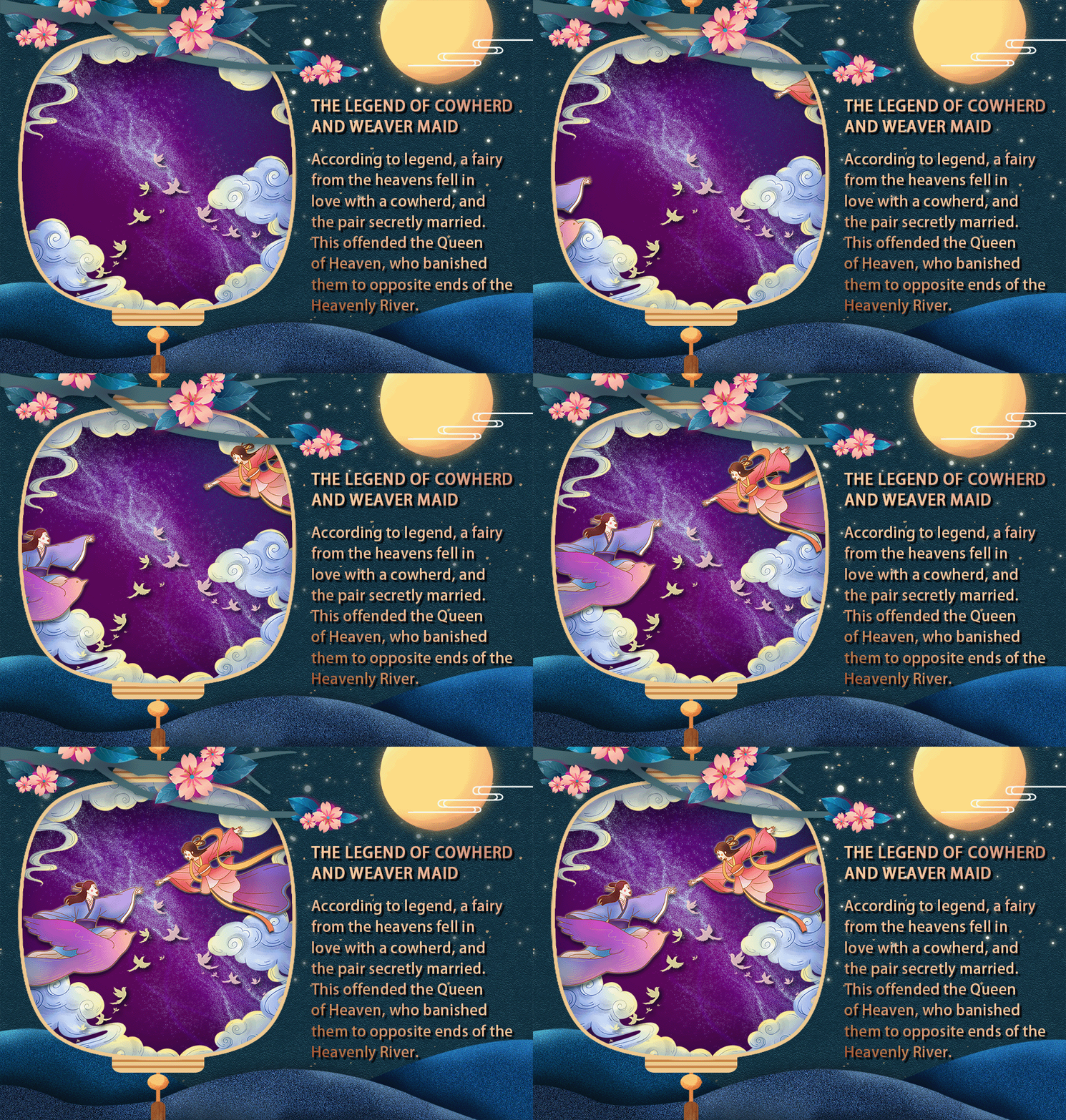
Long, long ago, there was an honest and kind-hearted fellow named Niu Lang (Cowhand). His parents died when he was a child. Later he was driven out of his home by his sister-in-law. So he lived by himself herding cattle and farming. One day, a fairy from heaven Zhi Nu (Weaver Maid) fell in love with him and came down secretly to earth and married him. The cowhand farmed in the field and the Weaver Maid wove at home. They lived a happy life and gave birth to a boy and a girl. Unfortunately, the God of Heaven soon found out the fact and ordered the Queen Mother of the Western Heavens to bring the Weaver Maid back.


Qixi Festival 2014 七夕節 Chinese Valentine's Day
Chinese Valentine’s Day – Qi Xi Festival (七夕节)

The Double Seventh Festival known in China as Chinese Valentine's Day, falls on the 7th day of the 7th lunar month. Also callded "Qi Xi Jie" or "Qi Qiao Jie", it is a traditional festival full of romance and important to ancient ladies, but not as well-known as other traditional festivals. Not so many Chinese people take it as a festival as before but are all familiar with the story behind it. Long time ago, there was a poor cowherd, Niulang. His parents died and he lived with his elder brother and sister-in-law, who were both mean and treat Niulang badly. They kicked Niulang out of the house and left him old clothes and an old ox. Niulang built a cottage at the foot of mountain and took good care of that old ox. One day the ox spoke to him and told that it used to be Taurus, a proud star in the night sky but was published due to his violation to law of the Heavenly Palace. The old ox told Niulang some goodness would come to the pond not far away from his cottage for having a bathe; Zhinu was among them, who is daughter of king in Heaven, the kind and the most beautiful; If he could take her clothes away, she would leave and become his wife. Niulang listened to the old ox and went to the pond at appointed day. 

When the goddness came and took off their silk ropes then jumped into the water. Niulang found Zhinu's clothes and hide away. Other goddesses witnessed Niulang and dressed up quickly and flew away, only Zhinu left. He had adored her from the first moment he saw her. They looked into each other's eyes. The heavenly girl told the poor cowherd that she would be his wife. They soon got married lived together in that cottage. Niulang worked hard to grow crops and Zhinv raised silkworms. They lived a simple but happy life, with a little boy and girl Zhinu give birth afterwards. One day the old ox died and they preserve the its hide according to its words left. At the same time, the king and queen of the heaven found that Zhinu married a man and had babies. The queen flew down to earth with her solders and caught Zhinu away. Niulang came back home and found Zhinu not at home, only the children left. The babies cried and told him where Zhinu was going. Niulang remembered what the old ox told him and placed the twins in wicker baskets on a pole to carry on his shoulder, put on the magic hide, and flew up, up into the sky. The queen noticed that Niulang was following them, she became angry, with wave of her arm, and a raging torrent immediately appeared between her group and Niulang. He could not get past this wide swollen river. Heartbroken, Niulang and his children could only look and weep bitterly. The King in his Heavenly Palace was moved by the sound of their crying, and decided to allow Niulang and Zhinu to meet once a year on the seventh day of the seventh lunar month.

This sad love story was passed down from ancient times, with little magpies were seen on double seventh day, as most of them fly to Milky River to form a bridge for the annual meeting of Niulang and Zhinu. In ancient times, the double seventh day was an important festival for young women and young girls. No matter poor or rich, they would put on their best clothes and place an incense burner in the courtyard and lay out some fruit as offerings. Then all the girls in the family would kowtow to Niulang and Zhinu and pray for ingenuity. But nowadays, these traditional customs were lost and most Chinese young people favored Western Valentine's Day, a great day to express love between lovers.

21/06/2026

Happy Father's Day 2026

Related image
Father's Day is celebrated on the third Sunday of June

Summer Solstice 2026 夏至 Xià Zhì

All you need to know: June solstice 2019
The sunset has been making its way north, as illustrated in this 2016 photo composite by Abhijit Juvekar

The June solstice – your signal to celebrate summer in the Northern Hemisphere and winter in the Southern Hemisphere – is today, June 21, 2023, at 15:54 UTC. That’s 10:54 a.m. CDT in North America on June 21. Translate UTC to your time. For us in the Northern Hemisphere, this solstice marks the longest day of the year. Early dawns. Long days. Late sunsets. Short nights. The sun at its height each day, as it crosses the sky. Meanwhile, south of the equator, winter begins.

What is a solstice? Ancient cultures knew that the sun’s path across the sky, the length of daylight, and the location of the sunrise and sunset all shifted in a regular way throughout the year. They built monuments, such as Stonehenge, to follow the sun’s yearly progress.

Today, we know that the solstice is an astronomical event, caused by Earth’s tilt on its axis and its motion in orbit around the sun.

read more

What is a Solstice?

solstice is one of the two times of the year when the positioning and tilt of Earth relative to the sun results in the most amount of daylight time or the least amount of daylight time in a single day. There are two solstices during the year: one that occurs around June 20–22 (usually June 20 or 21) and one that occurs around December 20–23 (usually December 21 or 22).

The solstices are traditionally considered to mark the start of summer and winter. But which season begins with each solstice depends on which hemisphere you’re in. In the Northern Hemisphere, the summer solstice occurs in June and the winter solstice occurs in December. In the Southern Hemisphere, it’s the opposite. The summer solstice results in the longest day of the year, meaning it has the most time of daylight, and the winter solstice results in the shortest day of the year, meaning it has the longest period of darkness.

In contrast, an equinox is one of the two times of the year when the amount of daylight and nighttime hours are just about of equal length. The two equinoxes occur around March 20–21 and September 22–23. In the Northern Hemisphere, the vernal equinox (or spring equinox) occurs in March and the autumnal equinox occurs in September. In the Southern Hemisphere, it’s the opposite.


read more

19/06/2026

Duān Wǔ Jié 端午节 Dumpling Festival 2026


The Dumpling Festival (端午节 “Duan Wu Jie” ), or Dragon Boat Festival, is celebrated on the fifth day of the fifth month of the Chinese lunar calendar
Zong Zi” (糯米) Bak Chang
Duān Wǔ Jié 端午节 Festival

Zongzi is a must-have food during Duanwu Festival. In ancient China, these traditional rice dumplings were used as an offering to pay tribute to ancestors and deities. Later, according to legend, after poet Qu Yuan plunged himself into the Miluo River, people threw zongzi into the water to divert fish away from his body. Zongzi are pyramid-shaped glutinous rice dumplings wrapped in reed or bamboo leaves and tied with colored thread. They are prepared with a wide range of fillings, including jujube and bean paste, fresh meat, ham and egg yolk.

Duanwu Festival is also called the Dragon Boat Festival. It's said that the festival may originate from dragon worship and that dragon boat racing reflects a reverence for the dragon deity. Folk tales also suggest that dragon boat racing is connected with the ancient poet Qu Yuan. After Qu Yuan drowned himself in the river to mourn the fall of his motherland, local people raced out in their boats to try and save him. Later, dragon boat racing became an indispensable part of the festival. Nowadays, it has developed into a sport which combines both Chinese tradition and the modern sporting spirit.

Realgar wine is a kind of Chinese liquor seasoned with realgar. Legend has it that an old doctor poured a jug of realgar wine into the water where poet Qu Yuan drowned himself, hoping to make all the creatures in the river drunk and prevent them from eating the poet's body. Past generations also used realgar as a pesticide against mosquitoes in the hot summer, and as an antidote against poison in ancient times. Now, drinking realgar wine has become a tradition during Duanwu Festival. Chinese people often hang mugwort above their doors to deter insects. In ancient times, people believed that hanging mugwort, calamus or pomegranate flowers could get rid of misfortune or drive away evil spirits. Also, venomous animals — such as snakes, centipedes and scorpions — were said to appear starting from the fifth day of the fifth month, and so people would hang mugwort or calamus, take long walks, and wear perfumed medicine pouches to keep venomous animals away and prevent diseases while promoting health and well-being.


Dragon Boat Festival: Names, Origins, Traditions, Greetings

Dragon Boat Festival is a traditional Chinese holiday which falls on the fifth day of the fifth lunar month, which is in late May or June on the Gregorian calendar.

Dragon Boat Festival is one of the four top traditional Chinese festivals, along with the Spring Festival, Tomb-Sweeping Day, and Mid-Autumn Festival. It is called Dragon Boat Festival, or Longzhou Jie (龙舟节) in Chinese, because of its close association with dragon boats. Chinese people attach great cultural significance to dragons. The two main activities during the festival are eating zongzi (rice dumplings) and boat races, and both are related to dragons. Zongzi have long been thrown into rivers as offerings and sacrifices to the Dragon God on lunar month 5 day 5, while dragon boats are used in races traditionally held on this day. So, it is also called the Dragon Boat Festival.

In addition to China, many other Asian countries also celebrate this festival. In Malaysia, Indonesia, Singapore, and Taiwan, it is known as Bak Chang Festival (‘Dumpling Festival'). Learn more facts about the Dragon Boat Festival:
  • The Festival Date Varies Each Year!
  • It Is an Important Public Holiday
  • It Is One of the National/UNESCO Intangible Cultural Heritage Items
  • It Is a Traditional Festival to Worship an Ancient Chinese Poet — Qu Yuan
  • The Most Ceremonial Activity Is Held — Dragon Boat Racing
  • Eating Zongzi is the Most Popular Custom
  • Special Plants are Hung on Doors to Discourage Diseases

31/05/2026

Happy Vesak Day 卫塞节 2026


Vesak Day

Vesak Day is a major event on the Buddhist calendar. It is a public holiday in Singapore which celebrates the birth, enlightenment and nirvana of Buddha. In Singapore this day is celebrated every year with the faithful visiting their nearest temple, preparing their offerings and then engaging in a number of rituals.

Each year, monks lead the way by chanting the sutras and the local people flock to the temples to make offerings to Buddha. During this religious holiday, local people will engage in a ritual known as Dana, which is an opportunity to show generosity. The Dana celebration involves releasing caged animals and birds. The day is also marked by visiting the poor and young people will often go to hospitals where they will donate blood. On Vesak Day, there are also candlelight processions through the city and visitors will be able to view these processions at Phor Kark See Temple on Bright Hill Road. As the devotees walk in procession, they will pray for peace and ask for personal blessings and repentance.

Some of the most interesting locations to visit during this day include Kong Meng San Phor Kark See Monastery which is Singapore’s largest temple which offers tours of the museum; the Vesak Carnival which is run by the Buddhist Fellowship and has food stalls, games, music and blessings; and the Amitabha Buddhist Centre hosts an event beside Aljunied MRT Station. Alternatively, visitors can go from temple to temple to view the many varied celebrations hosted on this day as there will be activities running from dawn till dusk, and well into the night. Vesak Day is a public holiday in Singapore, so many government buildings and banks will close, but most restaurants and malls will remain open.


Vesak Day

Vesak Day (Wesak Day) is an annual religious festival celebrated by the major Buddhist denominations in Singapore. While it is often referred to as “Buddha’s Birthday”, its actual significance is to mark the birth, enlightenment, and passing of Gautama Buddha, and is considered one of the most significant occasions in Buddhism. Vesak Day is usually celebrated on the first full-moon day of the Vaisakha month in the lunar calendar and typically lasts for a full day. This translates to April or May in the Gregorian calendar.

Vesak Day is celebrated in countries such as Japan, Sri Lanka, Thailand, and Myanmar where there are sizable Buddhist communities. Most Buddhist temples and monasteries in Singapore celebrate this festival, though the scale of the celebrations may vary. Theravada Buddhists in Singapore may visit temples such as the Sri Lankaramaya Buddhist Temple in St Michael’s Road and Wat Ananda Metyarama temple in Jalan Bukit Merah, and members of the Mahayana tradition may congregate in temples such as the Kong Meng San Phor Kark See Monastery in Bright Hill Road.

The festival is celebrated by the major Buddhist groups in Singapore, including Theravada, Mahayana and Vajrayana. The various temples and monasteries organise their own events and celebrations, with help from volunteers and professional suppliers and coordinators. Temples may often form a separate committee of volunteers to manage the Vesak Day celebrations. For example, in the Wat Ananda Metyarama temple, the committee includes Thai volunteers, volunteers from the temple’s youth division, and those from the community service groups of institutes of higher learning. Small temples may work with the Singapore Buddhist Federation (SBF) or with their larger counterparts to hold joint celebrations.

20/03/2026

Spring Equinox 2026 春分 Chūnfēn

What makes the spring equinox so special?

It takes a year for the earth to orbit the sun, and as it does so our planet spins on its own axis, each revolution taking a day.

If the axis of the earth was at 90° or perpendicular to the plane of its orbit, our planet would be very different. Sunrise and sunset would occur at the same time every single day.

We would also have no seasons and there would be a huge impact on weather patterns around the globe.

read more

What is an Equinox?

An equinox is one of the two times of the year when the amount of daylight and nighttime hours are just about of equal length. The two equinoxes occur around March 20–21 and September 22–23.

The equinoxes occur on these days, but an equinox is not the whole day—it is the moment when the sun is directly above Earth’s equator. The word equinox can also refer to the position of the sun at this moment. This can also be called the equinoctial point. The equinoxes are traditionally considered to mark the start of spring and fall. In the Northern Hemisphere, the vernal equinox (or spring equinox) occurs in March and the autumnal equinox occurs in September. In the Southern Hemisphere, it’s the reverse.

In contrast, a solstice is one of the two times of the year when the positioning and tilt of Earth relative to the sun results in the most amount of daylight time or the least amount of daylight time in a single day. There are two solstices during the year: one that occurs around June 20–22 (usually June 20 or 21) and one that occurs around December 20–23 (usually December 21 or 22). In the Northern Hemisphere, the summer solstice occurs in June and the winter solstice occurs in December. In the Southern Hemisphere, it’s the reverse.


read more

03/03/2026

Yuán Xiāo Jié 元宵節 Chap Goh Mei 2026


Rediscovering the romance of Chap Goh Mei


Chap Goh Meh in Teochew simply means "the 15th night of Chinese New Year". Aside from being tagged as the last day of the festival, Chap Goh Meh is also known as the Chinese Valentine's Day. On a celebratory point of view, this night sees the gathering of family members as they sit down to a meal together.

Just like Chinese New Year, Chap Goh Meh used to be celebrated with lots of fireworks and firecrackers which are now banned from use. Many homes gaily decorated with red lanterns and bright lights to mark the end of an auspicious occasion. Thanksgivings are held while many people would pray for success and wealth for the coming year.

Chap Goh Meh is also regarded as the Chinese Valentine's Day, bringing forth lots of fun and gaiety. Chap Goh Meh used to be a night of courtship and was a forerunner in promoting match-making. On this night, many young ladies would make their way to the Esplanade, dressed in their best, with hope of finding prospective suitors.

One of the fun activities that take place on this auspicious night includes the throwing of tangerines into the sea off the Esplanade by these young maidens. It is without a doubt, the most popular and colorful moment in the celebration of Chap Goh Meh. It is believed that by throwing tangerines into the sea, these young girls would find themselves a good husband. For many, the act of throwing tangerines into the sea also signifies that these ladies are available for marriage. It is also said that if someone else who sees the floating tangerine in the water and picked it up, that generally means that the single who threw it would be able to find a good spouse.

These are Memories of "The Good Old Days".

The 15-Day Celebration of Chinese New Year

Chinese New Year starts with the New moon on the first day of the first lunar month and ends on the Full moon 15 days later:

  • First day - zhengyue 1, ’Birthday of Chicken’
  • Second day - zhengyue 2, ‘Birthday of Dog’
  • Third day - zhengyue 3, ‘Birthday of Pig’
  • Fourth Day - zhengyue 4, ‘Birthday of Sheep’
  • Fifth day - zhengyue 5, ‘Birthday of Ox, Cattle’
  • SIxth day - zhengyue 6, ‘Birthday of Horse’
  • Seventh day - zhengyue 7, ‘Birthday of Men’
  • Eighth day - The Completion Day
  • Ninth day - The birthday of the Jade Emperor
  • Tenth to the Twelfth Day - More feasting with friends and family
  • Thirteenth day - A time to diet a bit after so much rich food
  • Fourteenth day, The Lantern Decoration Day
  • Fifteenth day, Lantern Festival

25/02/2026

Bai Tian Gong 拜天宫 2026

Hokkiens’ New Year 福建人的新年 9th day of Chinese New Year
“Gold” paper (kim chua) is hung from the sugarcanes, and this is later burnt as a thanksgiving offering to the Jade Emperor. A pair of sugarcanes are usually used, and traditionally these are tied to the sides of the altar

There is a saying that states you have not truly experienced Chinese New Year until you have celebrated it in Penang. The reason behind this is because Penangites celebrate Hokkien New Year in addition to Chinese New Year. You must be thinking – whatt? Hokkien New Year? How is this different from Chinese New Year?

Basically, Hokkien New Year is celebrated on the 9th day of Chinese New Year. (If you remember, I previously mentioned that Chinese New Year is a fifteen day celebration). For us Hokkiens, it is celebrated with more grandeur compared to the 1st day. According to mum, this is because the Hokkiens were in hiding for the first eight days of Chinese New Year, and only had the chance to celebrate the New Year on the 9th day. The belief is that the Jade Emperor (Thee kong – translated as “king of the heavens”) protected our Hokkien ancestors from being caught, which is why we offer thanksgiving prayers to him.

Although these prayers are traditionally only performed by Hokkiens, more and more non-Hokkien people have started to join in to pray for a good year ahead.

The prayers start at 11pm on the 8th day of Chinese New Year (in the Lunar calendar, the day starts at 11pm instead of at midnight), but preparations start well in advance. I went round with my mum to buy the fruits and flowers earlier in the day, and brought my camera along in the hope of capturing the festive air of it all. I must say I got quite a few strange glances from people, they must have thought I was completely crazy. Oh well.

Sugarcanes are an integral part of the thanksgiving prayers. This is because the Hokkiens hid out in sugarcane plantations, which managed to prevent them from harm. This is the only time of year when you will see this sugarcanes being sold all over town, and as you can imagine, it takes a bit of maneuvering to get the long stems into your car!

read more

The 9th Day of Chinese New Year Festival
A pair of sugarcane plants are used by the Hokkiens usually placed one on each side of the offering table or  the front door of the house

On the 9th day of the first month of the Lunar Calendar, it would be the celebration known to the Hokkiens as ‘Bai Tian Gong’, which literally means ‘praying the Heaven God’.

During a Chinese New Year of the Ming Dynasty, there was a bandit raid in the province of Hokkien. These intruders however robbed and burned down villages, attacked and killed the villagers. The people of the villages were in fear and escaped from their burnt villages during the night. Some of the villagers then hid themselves among the sugarcane fields. Needless to say, those villagers prayed to Heaven God (Tian Gong) for salvation during their hideout. The pursuing intruders spent many days trying to locate and hunt them but to no avail. On the ninth day of that Chinese New Year, they finally gave up and returned to their region. The Hokkiens then happily emerged from the sugar cane fields, and praising the blessings of the celestial deities and owing gratitude to the sugarcane plants for saving them from destruction. Thus, in all Hokkien celebrations, the sugarcane plant is given prominence.

Realizing that it was also the 9th Day of the Chinese New Year and coincidentally the birthday of Heaven God, they decided to make votive offerings and prayers to the Jade Emperor for their salvation. There are many versions of the Hokkiens’ Bai Tian Gong stories. Whichever it is, the Hokkiens believe that our life and prosperity are granted by the Heaven God. On the eve of the 9th day, a pair of sugarcane plants are used by the Hokkiens usually placed one on each side of the offering table or the front door of the house. The pair of the sugarcane symbolises unity, cooperation and strength. The sugarcane itself is a symbol of harmony and a token which can bring good and ‘sweet’ results. The very straightness of the sugarcane stem also ensures that the Hokkiens can become a clan of honest and sincere people.

read more

23/02/2026

Renri 人日 or Yan Yat 2026


PROSPEROUS YU SHENG FISH SALAD

Singaporeans believe the seventh day of the Chinese New Year (Renri 人 日) marks the occasion for people to gather and enjoy Lo Hei Yu Sheng, a tasty fish salad and popular specialty served every Chinese New Year on the Lion Island. It is associated with the hope of enhancing luck and good things in the New Year. Yu Sheng in Chinese stands for a prosperous life, indicating wealth and longevity.

It is a salad dish made with pieces of salmon, julienne-chopped radish and carrot, grapefruit wedges, roasted peanuts, roasted sesame and plum sauce. Each ingredient is prepared carefully for them to bring good luck and wealth. Fish indicates prosperity of the upper class; grapefruit indicates good luck and wealth; white radish indicates a successful business and a promotion; cooking oil indicates cash inflow.

The raw ingredients are put in a large bowl alongside seven more representatives of good wishes for the New Year including great happiness and advantages prosperity for the whole year, achieving thousands of desired things, wealth and prosperity, and so on. Family members or business partners stand around a table and use chopsticks to mix and tumble the ingredients for the dish as high as possible and speak their wishes for the New Year out loud. This mixing is known as ‘Lo Hei in Singapore, meaning prosperity’. Lo Hei Yu Sheng fish salad expresses the wish to thrive and experience prosperity in the New Year and has become an indispensable dish at every spring welcoming party organised by Singaporeans.


CNY dish: 七 样 菜 Stir Fried 7 Vegetables


Every 7th day of Chinese New Year (also called ‘Ren Ri’ ; 人 日), Ah-mm will tell me to go and buy 7 types of vegetables for her to cook 七 样 菜. 人 日 is literally ‘human day’. According to Chinese legend, 女 媧 created different animals on different days. Humans were created on the 7th day after she created the world, so Ren Ri is also known as everyone’s birthday. Don’t be surprised if a Chinese wishes you ‘Happy Birthday’ on this day!

Some markets will pre-pack the 7 assorted vegetables for you so you don’t end up with big bunches of everything. Ah-mm says there’s no hard and fast rule as to which vegetables go into the dish, but she insists on having Chinese leeks (大 蒜), pronounced ‘da suan’, which sounds like calculating (money). She also always got some 春 菜 (mustard greens) but it’s kinda hard to find. My 7 types of vegetables this year:
  • Chinese leeks (red leeks)
  • Spring onions
  • Chives
  • Celery
  • Cabbage
  • Puay Leng (Chinese spinach)
  • Xiao Bai Cai
You can add in some meat slices like lean pork, but I added bak gwa this year hehe. Slice the bak gwa into strips and fry them together with the leeks, chives and celery in the beginning, so that the entire wok has the smokey fragrance of bak gwa. But watch the fire to prevent burning. I like them a bit charred though!

read more

Lo Hei 捞起 Yúshēng 魚生
THE SIGNIFICANCE OF LO HEI & WHAT IT ACTUALLY REPRESENTS

The Chinese Lunar New Year is an annual festival where many traditions culminate from exchanging of oranges to the receiving of red packets and more. Still, as far as the Chinese New Year goes, the iconic yu sheng toss remains at the helm of all things festive. Yu Sheng, otherwise known as lo-hei or prosperity toss, is something that we’ve grown terribly fond of. A vibrant centrepiece dish comprising various elements, each boasting its own unique flavour and meaning behind it, the yu sheng is always the first order of business at any family gathering. Yet, as we find ourselves going through the motion of this tradition year in year out, how many of us millennials can actually say that we truly understand this practice and its significance? To a season dedicated to good fortune, family reunion and feasting, here is our guide on lo hei, what it is and what it represents.

Since its origins as a simple raw fish dish back in the 1930s, the recipe has undergone a series of transformations, and even until today, people are still finding innovative ways to present this dish. The dish was brought to Singapore in the late 19th century by the migration of Cantonese and Teochew migrants from China. “Lo Hei”, in Cantonese literally translates to “tossing up good fortune”, and it refers to the ritual adopted in Singapore that involves a group of people gathered around a massive plate, tossing its contents violently while saying out auspicious phrases before eating it—it is popularly believed that the higher the toss, the better your prospects and fortune in the year ahead.

At the very beginning, the salad itself consisted merely of raw fish slices, some vegetables and seasoning to taste. It was only much later on in 1964, where a quartet of chefs—known affectionately as the ‘Four Heavenly Kings’—reinvented the dish and served it at the then, newly opened Lai Wah restaurant. The new salad saw an improvement in texture, colour, and flavour. Key ingredients & what they represent:
  • Carrots – Represents good luck.
  • Green Radish – Represents eternal youth.
  • White Radish – Represents good job opportunities in the coming year.
  • Raw Fish – symbolises abundance and prosperity.
  • Pomelo – Represents luck.
  • Crushed Peanuts – Is a sign that your home will be filled with many valuable possessions.
  • Sesame Seeds – Represent the hope that your business will flourish.
  • Golden Crackers – Symbolises wealth.
  • Plum Sauce – A key component that binds the salad together, it represents stronger ties among family and friends.
  • Pepper & Cinnamon Powder – signify the wish for wealth
  • Oil – Often drizzled onto the salad in a circular motion rather than poured over. This is to symbolise that money will come from all directions.


Nián Nián Yǒu Yú 2024

Rabbitfish 白肚鱼 for Chinese New Year
Rabbitfish as a symbolic dish in Chinese New Year (CNY)

Rabbitfish is one of the must-buy food during Chinese New Year (CNY). The species commonly eaten is White-Spotted Rabbitfish. Its stomach region is usually bitter. CNY period coincides with their mating season, as a result, the fish taste great. Rabbitfish contains fish roe and milt (fish semen) during this time. Rabbitfish Milt tastes like soft tofu and with a tinge of seafood flavour. This is viewed as an abundance by the Chinese and will also buy it for its taste.

Fish is one of the most eaten food during the Chinese New Year (CNY). The word Fish (鱼yú) has the same pronunciation(余yú) as Chinese idiom 年年有余 (nián nián yǒu yú). Traditional Chinese idiom represents surplus all year round. It is one of the popular auspicious blessings during CNY festive season. Chinese choose Rabbitfish as one of the preferred fish even calling it “发财鱼” prosperous fish. Thus, it is common to buy Rabbitfish as a custom is to wish their loved ones prosperity and living in abundance during reunion dinner.  There will often be some leftover fish to symbolise surplus that matches the idiom. Most importantly, CNY reunion dinner is once a year, Chinese will definitely buy it during CNY.

White-Spotted Rabbitfish is also known as Spinefoots and they belong to the Siganidae family. Rabbitfish is a diurnal animal (active during the day). At night, it often hides in between rocks and corals. Younger rabbitfish form large schools, while the adults are usually seen in smaller schools. Some species can reach up to a length of 40 cm. White-spotted Rabbitfish is more commonly found up to 15cm. The rabbitfish elevated spines contain poison glands on its fins. These spines can be found on their fins. As Rabbitfish have venomous spines on their fins, you must act with caution when handling rabbitfish. Although not lethal, its sting can inflict great pain to people. While rabbitfish are not aggressive in nature, however, they do not hesitate to sting predators in self-defence. Rabbitfish is mainly herbivorous. Its diet is based mostly on algae. Some species of rabbitfish eat zooplankton, seaweed and corals.


Chinese New Year Traditions

Do you know what should we follow and the meaning of traditional customs and cultures for Chinese New Year celebration? Let’s us look at following tips, they help your celebration easier and have a Happy Chinese New Year:
  • Spring Cleaning: All family members will clean-up the house together on the 28th day (of the last month) of the (old) year. Spring Cleaning symbolizes that sweeping all misfortune or bad luck away from the house. Plum blossom symbolizes lucky and representing people are resilient, even in a harsh environment.
  • House Decoration: Red lanterns and red banners will be hung beside the door to keep in good luck and longevity.
  • Reunion Dinner: In New Year Eve, the whole family members will gather together and have a sumptuous dinner. If a family member could not come for the dinner, his or her presence is usually symbolized by placing an empty seat at the banquet.
  • Symbolic dishes: In the reunion dinner, some dishes are mostly being served as they hold a symbolic good meaning. For instance, prawn featuring smile always and fish featuring prosperity.
  • Shou Sui (守岁): People stay awake all night for increase longevity of the elderly family members.
  • Angpau: Angpau with lucky money or sweet inside were distributed to the young by elders. The red color of the angpau symbolizes good luck and also ward off evil spirits. 
  • Ancestor Worshiping: Chinese believe that deceased family members have a continued existence and they will look after the family.
  • New Cloth: New cloth especially in red colour will be worn during Chinese New Year as it symbolize a new start and monster Nian scared about this colour. Black and white is avoided during Chinese New Year because they represent mourning.
  • New Year Visits (Bai Nian): Chinese travels back to their home town to meet their family and also to visit relatives and friends.
  • Firecrackers: To scare away any traces of monster Nian, because it is afraid of noise.
  • Lion Dances: The loud beats of the drum and cymbals together with the face of the lion dancing can evict bad or evil spirits. Lion dance are popular for visiting houses and shops to perform the traditional custom of "Cai Ching" (采青) as people believed it can brings prosperity to people.
  • Sticky Cake (Nian Gao): To appeasing the appetite of the Kitchen God and also sticking his mouth to prevent him from speaking ill about the family. 
  • Yu Sheng (鱼生): To achieve prosperity and vigor, normally having Yu Sheng on renri (day 7).
  • Jade Emperor Ritual (Bai Tian Gong): The Hokkiens will have another family reunion dinner, and they pray to the Jade Emperor at midnight (day8). 
  • Lantern Festival: Children will go out at night carrying lanterns which symbolic of hope and good luck. People will eat Tang Yuan (汤圆) as it considered to family reunion.

19/02/2026

Nián Nián Yǒu Yú 2026


Rabbitfish 白肚鱼 for Chinese New Year
Rabbitfish as a symbolic dish in Chinese New Year (CNY)

Rabbitfish is one of the must-buy food during Chinese New Year(CNY). The species commonly eaten is White-Spotted Rabbitfish. Its stomach region is usually bitter. CNY period coincides with their mating season, as a result, the fish taste great. Rabbitfish contains fish roe and milt(fish semen) during this time. Rabbitfish Milt tastes like soft tofu and with a tinge of seafood flavour. This is viewed as an abundance by the Chinese and will also buy it for its taste.

Fish is one of the most eaten food during the Chinese New Year (CNY). The word Fish (鱼yú) has the same pronunciation(余yú) as Chinese idiom 年年有余 (nián nián yǒu yú). Traditional Chinese idiom represents surplus all year round. It is one of the popular auspicious blessings during CNY festive season. Chinese choose Rabbitfish as one of the preferred fish even calling it “发财鱼” prosperous fish. Thus, it is common to buy Rabbitfish as a custom is to wish their loved ones prosperity and living in abundance during reunion dinner.  There will often be some leftover fish to symbolise surplus that matches the idiom. Most importantly, CNY reunion dinner is once a year, Chinese will definitely buy it during CNY.

White-Spotted Rabbitfish is also known as Spinefoots and they belong to the Siganidae family. Rabbitfish is a diurnal animal (active during the day). At night, it often hides in between rocks and corals. Younger rabbitfish form large schools, while the adults are usually seen in smaller schools. Some species can reach up to a length of 40 cm. White-spotted Rabbitfish is more commonly found up to 15cm. The rabbitfish elevated spines contain poison glands on its fins. These spines can be found on their fins. As Rabbitfish have venomous spines on their fins, you must act with caution when handling rabbitfish. Although not lethal, its sting can inflict great pain to people. While rabbitfish are not aggressive in nature, however, they do not hesitate to sting predators in self-defence. Rabbitfish is mainly herbivorous. Its diet is based mostly on algae. Some species of rabbitfish eat zooplankton, seaweed and corals.


Rabbitfish season brings family and friends together for CNY
Rabbitfish is also known as “fa cai yu”, or “get-rich fish”, as it is believed to bring prosperity. PHOTO: MOH ZAKARIA

Rabbitfish is a popular dish that tastes best during Chinese New Year, as its mating season coincides with the festive period and it is said to taste less fishy when filled with roe and milt, the male equivalent of caviar. For some families here, the dish even has a convening power, bringing together extended family and triggering memories of childhood reunion dinners. A group of 19 people from Singapore celebrated this Chinese New Year by feasting on the tropical fish. On Feb 10, Ms Jennifer Chang, 57, took her family to Kiki Beach Resort, a resort on Galang Island near Batam, Indonesia, to savour the delicacy and bring back memories of her late mother’s cooking.

Some of their friends also joined in the festivities. The youngest in the group was four years old and the oldest 62. It was the first time Ms Chang has gathered with her siblings to have rabbitfish since their mother died seven years ago, she said. She hoped to reminisce about the times they spent having rabbitfish with their mother while enjoying the sea view and activities at the resort. “She was the only one who prepared (the fish) for me, so I have missed this dish for many years,” said Ms Chang. “She would try to steam it for me throughout Chinese New Year. I would get many rounds of rabbitfish, as long as they sold it in the market.” Her mother would steam rabbitfish Cantonese-style with garlic, red chilli, sesame oil and soya sauce for the family, she said, adding that it is her favourite way of enjoying the fish. The dish was cooked only during Chinese New Year because rabbitfish are small and do not contain roe when it is not mating season. “Even though my mum’s cooking was always the best, I’m grateful to Kiki Beach Resort for this special treat,” Ms Chang said. The owner of the resort, Mr James Poh, 59, said mating season for rabbitfish lasts around a week during Chinese New Year, starting from Feb 5 and ending before Feb 15 in 2024. During that time, the meat of the fish tastes firm and sweet, he said. As for its roe, he likened it to foie gras, which is creamy and smooth.


Teochew Style Steamed White-spotted Rabbitfish

Every year before and during Chinese New Year (CNY) period you would definitely be able to see this auspicious "White-spotted Rabbitfish(白肚鱼/拜年鱼)" available at all wet market fish stalls as well as the seafood sections at major supermarkets. These fish taste especially delicious during this season and they are also big in size and comes with roes that are particularly relished too.

Last year I have shared with you a similar Teochew style recipe known as "Pan-fried White Spotted Rabbitfish With Leeks"(recipe HERE) whereas for this year it would be the steamed version which consists similar ingredients. My dad used to cook this dish and according to my mum who taught me this recipe over our phone conservation, she mentioned that in order to maintain the texture and taste of the fish it would be good if I blanched it in boiling water before steaming. (in this case the fish is half cooked and it would not release so much water during steaming which will affect the texture of the meat).

So since I wanted to achieve what my dad used to cook for us, I follow my mum's suggestion and steps to dot and surprising it works well. My steamed white-spotted rabbitfish taste almost 90% like my childhood food. Now at least I have master another traditional food in our household which might comes in handy one of these days.


Teochew-style Steamed White-spotted Rabbitfish 潮式清蒸白肚鱼

This is a signature Teochew dish. The Teochews love their ingredients fresh and the steamed rabbitfish is part and parcel of an elaborate spread that the Teochews eat for brunch called the “Teochew Muay” (潮州糜). Teochew Muay can be likened to the Spanish tapas, where one consumes a large selection of small dishes except that the meal is eaten with plain rice congee.

The consumption of rice congee with a huge platter of at least ten side dishes is a key feature of Minnan cuisine. This practice can be seen from Taiwan to Shantou in Canton where the Teochews live. As a result of the Teochew diaspora, Teochew Muay is eaten in Thailand, Cambodia, Malaysia, Singapore and even in France. What mainly distinguishes Teochew Muay from the other Minnan rice congee spreads, is this dish, the steamed White-spotted Rabbitfish.

Ingredients:
white-spotted rabbitfish (known in Teochew as “Bair Tor Hir”), descaled and gutted
2 cloves of garlic, shelled and minced
5g fresh ginger, sliced and cut into strip
2 tbs peanut/sunflower oil
2 tbs Shaoxing rice wine
5 ts Chinese fermented soy bean paste
salt and white pepper powder to taste


Steamed White Spotted Rabbitfish - 清蒸白肚鱼

Fish is very commonly eaten during the Chinese New Year because fish in Chinese (鱼) sounds the same as excess in Chinese (余). What many people do not know is that there is a certain delicacy that can be found in our local wet markets. This special delicacy is the rabbit fish. Most of you would know rabbit fish as a common, affordable fish... except during the Lunar New Year season. For a few days in a year - and only for a few days - the rabbit fish sold in local markets are full of creamy roe or milt (fish semen).

It is believed that eating the rabbit fish when its stomach is full of roe or milt is a sign of prosperity. In particular, the Teochews in Singapore believe that eating rabbit fish (pek tor he in Teochew dialect) will ensure good luck for the coming year.

The best way to eat this delicacy during Lunar New Year is to steam it for about 3-4 minutes. You will know that it is cooked when the fish eyes turn white. Eat it with a mixture of lime, soy sauce, chilli and garlic (optional). Remember, don't overcook it so that the roe is not hard but creamy. Last but not least, eat with the joy of looking forward to a fresh new start to the new year, where all things are possible.


Siganus canaliculatus

Siganus canaliculatus, the white-spotted spinefoot, white-spotted rabbitfish, pearly spinefoot, seagrass rabbitfish, slimy spinefoot or smudgespot spinefoot is a species of marine ray-finned fish, a rabbitfish belonging to the family Siganidae. It is native to the western Pacific Ocean and Indian Ocean where it occurs on reefs and in lagoons.

Siganus canaliculatus was first formally described in 1797 as Chaetodon canaliculatus by the Scottish explorer Mungo Park with the type locality given as Bengkulu Province on Sumatra. This taxon is largely sympatric with the mottled spinefoot (Siganus fuscescens) and these taxa are also very similar in appearance. Molecular analyses in 2011 found that there were three separate lineages within S. canaliculatus and S. fuscescens, that these lineages interbred and that each lineage had specimens which referred to either taxon, this suggests that S. canaliculatus is a junior synonym of S. fuscescens. This is not the position taken by FishBase[6] or Catalog of Fishes. The specific name canaliculatus means “grooved”, a reference to the grooves in the fin spines. Park did not know that, like all rabbitfishes, these spines contained venom glands for defence.

Siganus canaliculatus has a moderately slender, laterally compressed body, the standard length being 2.3 to 2.8 times its depth. The dorsal profile of the head is weakly to notably concave over the eyes with a pointed snout. The front nostril has a flap, in juveniles this covers the rear nostril, although it becomes shorter as the fish grows and is completely absent in the oldest fishes. The dorsal fin has 13 spines and 10 soft rays while the anal fin has 7 spines and 9 soft rays. The front spine on the dorsal fin points forwards. The caudal fin is nearly emarginate in smaller individuals of less than 10 cm (3.9 in) standard length becoming forked in larger fish. This species attains a maximum total length of 40 cm (16 in), although 20 cm (7.9 in) is more typical. The colour and pattern of the white-spotted spinefoot is very variable. It can be greenish grey to yellow brown and is marked with 100-200 perlescent blue to whitish spots on the nape and anterior part of the body, these are similar in size to a match-head on the lower flanks. There are 2 to 3 rows between the first spine of the dorsal fin and the lateral line, which are roughly one sixth the size of the eye, and another 10 or so rows between the uppermost point of the lateral line and the base of the first spine in the anal fin. Alarmed or injured fishes adopt a pattern where their flanks are mottled with patches of light and dark brown and cream, forming a pattern of 6 or 7 uniformly spaced, dark oblique zones with lighter zones of similar breadth separating them. There is normally dark spot immediately to the rear of the upper end of gill opening, this spot is similar in size to the eye, and a thin bar along the upper margin of the operculum.