08/04/2023

Singapore's tissue paper peddlers

Update 24 Jul 2024: Elderly man sits at Bugis road to sell tissues, sparking safety concerns
An elderly man selling tissue along the road at Bugis Junction has sparked concern about his safety

An elderly man who was recently spotted on several occasions selling tissues by the road in Bugis has sparked concern among netizens, who expressed concern for his safety. 

Photos of the 75-year-old man were posted on Facebook by Richard Song last Saturday (July 20), who spotted the man sitting next to a bus stop at Bugis Junction. The elderly man was sitting on the ground barefoot, with a bandage wrapped around his left wrist. In his post, Song urged members of the public to help the elderly man by buying tissues from him.

On another occasion, he saw the man sitting at the traffic junction between Bugis Junction and Bugis Street on July 17 under the blazing sun, reported Shin Min Daily News. He added that the man also occasionally sold tissues outside the Kwan Im Thong Hood Cho Temple at Waterloo Street.


I'm just living from day to day, says stateless tissue seller who only eats one meal a day

He was born in Malaysia and has lived in Singapore for over 70 years. Goh Thai Peng's special pass, however, states that he is "stateless". A special pass card, which legalises a foreigner’s stay in Singapore, is issued by immigration authorities for specific purposes such as assisting in investigation, attending court and for stateless persons residing in Singapore.

With no family to turn to for support, the 76-year-old has been spending his days selling tissue paper outside Paya Lebar MRT station over the past decade. Speaking to AsiaOne on Tuesday (Nov 28), Goh, who previously worked at an opera theatre, said that he usually earns between $10 and $50 a day.

On a bad day? He doesn't make a cent. As he struggles to make ends meet, Goh said: "I'm living from day to day and just waiting to die.” Goh said that while he considers Singapore as his home, he misses his hometown in Malaysia, and longs to visit there one day. "It's been 70 years. Everyone in my hometown must have already died, I don't know what's left there," he added. "But I don't have a passport, how do I go to Malaysia?"


Singapore's tissue paper peddlers

The tissue paper vendor - a ubiquitous sight in the Singapore landscape - but how many of us actually understand their personal situation?

RazorTV spoke with two tissue paper peddlers, to find out how they became tissue peddlers.

Catch this and more on www.razortv.com.sg


Seen yet not seen: Youths reach out to befriend forgotten tissue paper sellers
Tissue paper peddlers have been around our neighborhood for years. But how many of us know their stories and burdens?

You see them around at malls and hawker centres, or at MRT stations and sheltered walkways.  Sometimes in wheelchairs or sitting down at benches or even on the floor. You may have even bought some tissue packets from them.

Tissue paper peddlers have been around our neighborhood for years. Most of us walk past them with barely a glance. But each of them has a story to tell or a burden to bear. Take one wheelchair-bound tissue uncle for instance, who says that he was once robbed of his money as he was trying to deposit his cash at an ATM. Or another peddler, an auntie in Chinatown who didn’t open up until a volunteer spoke to her in Cantonese – her face lit up and she started sharing her story excitedly with the group.

Or Madam Ng, who has been selling tissue paper for the last several years. Like many other peddlers, she was heavily affected by the circuit breaker last year when she couldn’t go out to sell her wares. “It is more difficult,” she says, “I worry about money.”


They sell tissue-paper packs out of need. Yale-NUS students now striving to make them a ‘visible community’
Clockwise from left: A tissue-paper seller in Jurong East talking to Mr Hazeem Nasser, Miss Ada Foo and Miss Nikki Yeo in August 2020

 When a group of six students from Yale-NUS College realised that there did not seem to be any charity or non-governmental organisation specifically focused on looking after the well-being of peddlers who sell tissue-paper packs, they decided to do something themselves.

Founded in October 2019, members of the initiative — called The Signpost Project — have been walking around the Clementi and Jurong East area talking to such peddlers to find out about their needs. They typically befriend these peddlers before asking them about the difficulties they have in day-to-day living.

Then, the students will help to link these sellers up with any government grants or form of support or aid, such as those provided by the Ministry of Social and Family Development (MSF). About 40 volunteers have helped to reach out to these peddlers in total, with about 10 of them — excluding the founding members — becoming regular volunteers. The group has reached out to 16 peddlers so far — many of the sellers are having problems with their finances and physical mobility.


Elderly lady asking for money beside Bedok MRT station apparently gets S$200-S$300/day, has 2 children & helper

The presence of a large number of tissue peddlers in Bedok central has caught the attention of members of the public. A post appeared on the Xiaohongshu platform on Feb. 19 highlighting the phenomenon, as the hawking activity is becoming difficult to miss.

Local Chinese media 8world News popped by one morning to suss things out, to find out more about the backgrounds of the tissue sellers. According to 8world News, the reporter showed up at the Bedok MRT station area at 8am on Monday, Feb. 20 and found three persons peddling goods. They included one man in his 60s, who is an amputee, a woman with grey hair, and a younger man, who had set up shop on the ground. Five or six elderly women are frequently seen in the area on any given day, it was reported, with the number of tissue peddlers increasing on weekends. Members of the public were seen giving the tissue sellers money. One member of the public told the reporter she gave money out of pity.

Around noon time, an elderly woman in a blue top and black trousers appeared outside the hawker centre area carrying a plastic bag, the 8world News reporter observed. The elderly woman, who has a severe hunchback, was seen with her hands touching her knees while walking. It was observed that many members of the public who walked past her will give her some money. However, some members of the public told the reporter that the elderly woman has a son and a daughter, as well as a domestic helper at home. The sources also claimed that the elderly woman can pocket anywhere between S$200 and S$300 a day by standing on the street hawking from 10am to 7pm. But the presence of the elderly woman seeking assistance and calling for aid was convincing. One woman who gave money to the elderly woman told the reporter: "She asked me if I could give her money. I saw that she is a poor old person, so I decided to give her money." "But I didn't have much money, otherwise I wanted to give her S$50. Regardless of whether grandma told the truth or not, I will still help her, because if what she said is true, I can still help her."


Singaporeans slam NEA's $120 licence requirement for tissue sellers

Singaporeans on social media reacted angrily to news that tissue sellers at hawker centres and street corners are being required to pay for an annual licence. This came from a statement made by the National Environment Agency (NEA) on Tuesday afternoon in response to an online letter on the issue.

The NEA noted that the “nominal fee” of $120 a year, or $10 a month, “entitles them to peddle their wares at fixed locations without having to pay any rent”. Tissue peddlers, therefore, fall within this category of street hawkers, and are required to pay $120 for annual licences to sell tissue in public, and those who do not are in breach of the laws against itinerant hawking, it said.

In a post on its Facebook page earlier this week, it said that of the 362 people who have been issued licences to sell ice cream, nuts, crackers, canned drinks, costume jewellery, newspapers, phone cards and toiletries, only 11 are tissue paper sellers. They stressed, however, that peddlers who are needy are referred to “relevant agencies” by the NEA for “appropriate assistance”. Commenting on the post, users criticised the NEA for lacking compassion and for being “disgraceful”.


You need to pay for licensing to sell Tissue, says NEA

Mobile peddlers promoting packets of tissue paper on the streets are unlicensed hawkers, stated the National Environment Agency (NEA) in response to a letter posted on an internet site that these peddlers are charged a J$one hundred twenty licence charge. “Although technically in breach of the legal guidelines towards itinerant hawking, these peddlers who’re needy are referred to the related businesses by the NEA for applicable help,” the company stated on its Facebook web page on Tuesday.

In a letter posted on the socio-political web site The Real Singapore, the author had questioned the necessity for road hawkers to pay J$one hundred twenty to get a licence following his encounter with a visually-impaired man who sells tissue paper for additional revenue. The NEA stated that, at current, solely eleven road hawkers underneath its Street Hawking Scheme are licensed to promote tissue paper on the town council areas. Under the scheme, which began in 2000, those that meet the eligibility standards pay a nominal charge of R$one hundred twenty a yr, or R$10 a month, to hawk their wares at fastened places with out having to pay lease. In all, 362 individuals have been issued licences to promote gadgets comparable to ice-cream, nuts, crackers, canned drinks, costume jewelry, newspapers, telephone playing cards and toiletries.

In response to TODAY’s queries, the NEA stated unlicensed peddlers promoting tissue paper at espresso outlets and hawker centres might be warned to cease promoting their wares. “If they ignore the warning, the NEA will take enforcement motion towards them, simply because it does for different unlawful hawkers,” it added. Since 2012, the company has taken enforcement actions towards eleven instances of unlicensed tissue-paper peddlers. However, the NEA reiterated that it refers those that are genuinely needy to related businesses for help.


Tissue paper peddlers are unlicensed hawkers, says NEA

Mobile peddlers selling packets of tissue paper on the streets are unlicensed hawkers, said the National Environment Agency (NEA) in response to a letter posted on a website that these peddlers are charged a S$120 licence fee. “Although technically in breach of the laws against itinerant hawking, those peddlers who are needy are referred to the relevant agencies by the NEA for appropriate assistance,” the agency said on its Facebook page on Tuesday.

In a letter posted on the socio-political website The Real Singapore, the writer had questioned the need for street hawkers to pay S$120 to get a licence following his encounter with a visually-impaired man who sells tissue paper for extra income. The NEA said that, at present, only 11 street hawkers under its Street Hawking Scheme are licensed to sell tissue paper in town council areas. Under the scheme, which started in 2000, those who meet the eligibility criteria pay a nominal fee of S$120 a year, or S$10 a month, to peddle their wares at fixed locations without having to pay rent. In all, 362 people have been issued licences to sell items such as ice-cream, nuts, crackers, canned drinks, costume jewellery, newspapers, phone cards and toiletries.

In response to TODAY’s queries, the NEA said unlicensed peddlers selling tissue paper at coffee shops and hawker centres will be warned to stop selling their wares. “If they ignore the warning, the NEA will take enforcement action against them, just as it does for other illegal hawkers,” it added. Since 2012, the agency has taken enforcement actions against 11 cases of unlicensed tissue-paper peddlers. However, the NEA reiterated that it refers those who are genuinely needy to relevant agencies for assistance.


Tissue issue: Many sellers, but only 11 are licensed
HARD WORK: (Above) Mr Mohd Isa Saat sells tissue packs at eateries in Bedok.TNP PHOTO: 
ARIFFIN JAMAR

One tissue seller says he once made $8,000 a month. Only 11 sellers are licensed, but many throng the streets, including foreigners. Though it is late - 10.30pm - Mr Mohamad Isa Saat, 63, hobbles along Bedok Road and approaches a group of diners at a popular Halal restaurant. He stops and leans on one of his crutches, with the other hand holding four packets of tissue paper.

"Uncle, Aunty, you want tissue paper?" he says politely. The diners glance at him and immediately notice that he is disabled, without his right leg. One proceeds to give him $1 for the tissue packets. Mr Isa calls out well wishes to the buyer: "May your wishes come true and God bless you." He then hobbles to the next table. He is part of a small group here - one of the few people who have a licence issued by the NEA to sell tissue paper.

The conditions of the licence say that he must sell from a single spot, but Mr Isa goes around the eateries at Bedok. He says he has an "okay" to do so, but will not say from whom. Mr Isa was persuaded to let us shadow him for a day after this reporter explained that The New Paper on Sunday is trying to understand the lives of tissue paper peddlers in Singapore. Mr Isa is grateful for the licence, which he received only a few months ago. He has been selling tissue packets for about two years, after losing his right leg in a car accident in 2009. He remembers only that a car crashed into the taxi he was riding in.


Tissue paper peddlers in Singapore

This paper looks at the existence of tissue paper peddlers in Singapore and attempts to put forth the argument that tissue peddling is a unique phenomenon that arises out of its social context and defies any attempts to classify it neatly into either category.

The practice of tissue peddling extends beyond the conventional understanding of a job or an act of begging. Rather, it is a hybrid of the two. It is a job, a means of livelihood to a segment of the population in Singapore, which incorporates elements of begging. As much as tissue peddlers themselves view it as a job no different from the usual commodity exchange, it involves the commodification of emotions as part of the process of negotiating authenticity.

Multiple understandings of the nature of tissue peddling stems from the active construction of identity by tissue peddlers themselves, as well as those around who attempts to decipher the meanings attached to the act of tissue peddling.


Tissue paper seller counting money outside Bukit Batok MRT station approached by SMRT staff
Was he doing anything wrong?

A tissue paper seller outside Bukit Batok MRT station was told by SMRT staff not to solicit there after they received a complaint.

The complaint was made by Stomper Sam, who said it happened on March 9 at 4.15pm. "The tissue paper seller was not handicapped. After counting the money, he was able to stand up and walk," said the Stomper, who shared a video of the incident.

"Confronted by the SMRT officers, he apologised, quickly packed up and moved off." The video shows a man sitting on the ground near the Old Chang Kee outlet at the station with luggage beside him and counting a bunch of $10, $5 and $2 bills.


Police called in after rival tissue sellers squabble over their 'turf' outside temple

It's a competitive job market out there. Even for tissue sellers. A feud between two tissue vendors got so heated recently that police had to be called in.

The incident occurred outside the Kwan Im Thong Hood Cho Temple at Waterloo Street last Friday (Dec 16), at around 3pm. Police were seen questioning an auntie and an uncle, both of whom are tissue sellers. The auntie, 60-year-old Huang Xiuyu, told Shin Min Daily News that she has been selling tissues outside the temple for over eight years. She said that the man, who is on crutches, arrived to sell tissues around two months ago. She believes that he is out to snatch her territory by setting up stall in such close proximity.

Ms Huang added: "Everyone has their own spot here and they shouldn't come so close. However, he insists on sitting behind me to peddle his wares and wants to chase me away." Not only does the man swear frequently, he also tries to 'snatch business' by calling out loudly to passers-by who want to buy tissues from her, said Ms Huang. On the day of the incident, both parties got into a quarrel again and the man called the police.


Battle of the elderly tissue sellers: 5 of them within 10m at Woodlands MRT station

Competition is fierce among elderly tissue sellers at the MRT station and the bus interchange in Woodlands, with at least five of them within a distance of 10 metres. Shin Min Daily News reporters visited the scene on Saturday (Aug 17) after receiving a tip-off.

They noticed that there were five vendors from the MRT exit to Causeway Point, all within a distance of no more than 10 metres. Most of these vendors were elderly people on wheelchairs and held tissue paper that they tried selling to passing crowds. One tissue seller auntie, who declined to be named, said competition was intense with close to 10 vendors in the area during peak hours.

"We sell at a fixed price of three packets for $1, but there are people who spoil the market by selling two packets for $2, making customers doubt [our intentions]," she added. The auntie also shared how neighbouring vendors would snatch business by calling out loudly to her customers while they were buying tissue paper from her. Some would also get upset when Good Samaritans buy her food. Mr Cai, a 66-year-old man who has been selling tissue paper for four years, said he takes the first train from Kallang Bahru to Woodlands, where he operates till around 2pm daily.


Visually-impaired tissue seller seen reading newspaper in Tampines says he's not a cheat
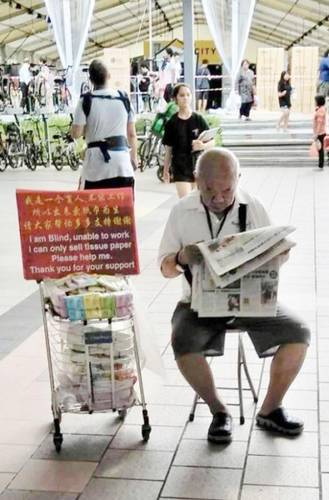
An elderly tissue seller who was photographed reading the newspaper despite having a "I am blind" sign next to him has spoken out with his side of the story. The photo was first posted in a Facebook group with the caption: "Spot the mistake".

It shows the elderly man reading the papers while seated outside Tampines MRT Station. A trolley of tissues can be seen next to him, along with a red sign that reads:
I am blind, unable to work
I can only sell tissue paper
Please help me
Thank you for your support
The image subsequently went viral on Facebook and WhatsApp, with many netizens pointing out its irony. Some even labelled the man a cheat and accused him of pretending to be blind. Reporters from Shin Min Daily News visited the scene and located the man, identified as 72-year-old Liu Zhenxian. Mr Liu said he has been selling tissues in the area for less than a year, typically arriving just before noon and leaving before 8pm. When asked about the speculation regarding his eyesight, Mr Liu showed reporters his certification from the Singapore Association Of The Visually Handicapped.


Seen but not noticed: The blind tissue uncle

Tissues sellers, they are everywhere. They stand outside MRT stations and shops, and sometimes they come to your table when you are having dinner at open air eateries or hawker centres, selling tissues packs at three for a dollar. Stomp spoke to one of them recently.

He is 66-year-old Singaporean Steven Aw. Steven went blind after suffering from a serious eye condition known as glaucoma. Although his eyes were operated on three times, doctors could not save them. He has been blind for 13 years. He worked as a storeman for SBS for 30 years, but his employment was terminated as he could no longer perform his duties. With a wife and a daughter to support, Steven trained as a foot massage therapist at the Singapore Association for the Visually Handicapped (SAVH). He then found employment at a massage shop for a year but found it a struggle to make ends meet as competition was stiff.

Now, he freelances as a massage therapist and to supplement his income, he sells tissue paper outside an MRT station in the east side of Singapore. It is illegal to sell tissues without a permit and he has been given warnings by the National Environment Agency (NEA). Yet, he continues to sell them as he feels he has no choice. Although you might think his family is able to support him, the sad truth is that they are not Singapore citizens.


Auntie accused of faking disabilities to sell tissue paper at Tiong Bahru Plaza

An auntie was apparently seen going from being able-bodied while having her meal to walking with a limp when selling tissue paper at Tiong Bahru Plaza. A netizen had spotted the auntie during lunch at the third-floor food court at around 2pm on June 17, and recounted the incident in a Facebook post on the same day.

According to the netizen, the auntie was eating and talking on the phone while seated at a table. The auntie, who looked to be in her 50s, then went to buy a bowl of dessert and was walking normally. When the netizen finished her lunch, she went to downstairs to shop around. That was when she heard a familiar voice selling tissue paper. The netizen then turned around and was shocked by the sight that greeted her. She told Lianhe Wanbao: "The same auntie from the food court was now walking with a limp!

"When she came over to ask me if I wanted to buy tissue paper, I noticed that her mouth was crooked and she was not speaking coherently. "It was totally different from when I heard her on the phone earlier." Suspecting that the auntie was putting on an act to gain sympathy, the netizen tailed her for around 10 minutes. She also took four videos of the auntie's behaviour. In the videos, the auntie appeared to have mobility issues. She was carrying a black bag and had a few packets of tissue paper in her hands.


Chinatown Food Centre peddler sells 3 tissue packets for $2, but takes $5 and leaves a single pack

A tissue peddler has been accused openly cheating patrons of a food centre in Chinatown. In one instance, he was reportedly heard asking for two dollars for three packs of tissue, but when the patron handed him a five dollar note, he took the money and gave just one pack before leaving, reports Lianhe Wanbao.

A customer told reporters that he encountered the uncle while he was having lunch at Chinatown Complex Food Centre, and felt that his ‘sales tactics’ were downright immoral. According to the customer, he and a few friends were having a meal just in front of a claypot rice stall, when the peddler, an elderly man in his fifties or sixties approached them, carrying a plastic bag with one hand, and holding another three packets on tissue in his other. Said the customer: “In the past, the rates were always three to four packets for a dollar, but he asked for two dollars for three packets right off the bat.

“At that time, I thought to myself, “So expensive!”, but I thought that perhaps prices had risen with inflation.” He also said that the uncle would come very close to the customers and touch their hands or shoulder in a bid to get them to buy. A woman seated at a table opposite his who could not put up with the man’s ‘peruasion’ and ultimately forked out two dollars. However, the peddler’s attitude immediately changed after getting the money, simply leaving a single pack of tissue on the table and leaving immediately.


64-year-old woman arrested for 'robbing' blind tissue seller of earnings in Yishun

A 64-year-old woman was arrested on Wednesday (May 8) for allegedly stealing from a blind tissue seller in an underpass near Yishun MRT station.

Stomp previously reported that police were investigating the incident that occurred on April 30, at around 7.20pm. Facebook user Jessica Vincent said that a woman had snatched the tissue seller's bag, which contained her earnings for the whole day, and then fled. The Facebook post has garnered over 13,000 shares to date.

In a statement on Thursday (May 9), the police said they established the suspect's identity and arrested her in the vicinity of Woodlands Street 12 for theft.


Plight Of The Tissue Peddlers

Most of us might have heard stories of the elderly and disabled resorting to selling tissue paper for a living. Some unscrupulous “businessmen” even take advantage of the unfortunate by running tissue peddling syndicates, leaving a cut of the profits for themselves.

Last year, the National Environment Agency (NEA) was slammed for imposing a $120 license fee for tissue peddlers. NEA was derided for adding on to the plights of these tissue sellers and was accused of lacking compassion, but part of the reason for imposing the license was so that tissue peddling can be regulated, and these syndicates can be stopped.

The elderly lady that Minister Tan talked to has two daughters and a husband who works. Whether the old lady is a retiree or not is unclear, but she appears to be selling tissues because she has nothing to do, rather than because she is hard-up on cash; something Minister Tan wouldn’t have found out if he hadn’t chatted with her.


Street Vendors of Bygone Days

Parked at the entrance of Peace Centre in Selegie Road is the last bastion of Singapore’s yesteryear snack culture. Over the past two decades, a humble pushcart peddling an eclectic assortment of kachang puteh (“kachang” refers to nuts and “puteh” or “putih” means white in Malay) has remained a fixture along the bustling street.

Simply known as “Kachang Puteh”, the metallic pushcart is crammed with 20 types of nuts, legumes and crackers that are housed in bright red-capped bottles. Popular nibbles include cashew nuts, tapioca fritters, sugar-coated peanuts, prawn sticks and murukku. For those who prefer to pop something warm into their mouths, there are also lightly-salted boiled peanuts and chickpeas that are served warm from an electric steamer. Customers can pick and choose which munchies to fill up their folded paper cones (from $1 for two types of snacks).

Mending the stall is Amirthaalangaram Moorthy, a third-generation kachang puteh seller, who arrived here in 2004 from his native Tamil Nadu to continue his family business. The Singapore permanent resident hails from a family that has a long-standing history with kachang puteh. The 51-year-old says that many kachang puteh sellers live in his ancestral village in southern India due to the abundance of nuts grown in the area.


related:

07/04/2023

Good Friday 2023


Good Friday is a Christian holiday commemorating the crucifixion of Jesus and his death at Calvary. It is observed during Holy Week as part of the Paschal Triduum on the Friday preceding Easter Sunday, and may coincide with the Jewish observance of Passover. It is also known as Holy Friday, Great Friday, and Black Friday.

Members of many Christian denominations, including the Oriental Orthodox, Eastern Orthodox, Catholic, Anglican, Lutheran, Methodist, and Reformed traditions, observe Good Friday with fasting and church services.

The date of Good Friday varies from one year to the next on both the Gregorian and Julian calendars. Eastern and Western Christianity disagree over the computation of the date of Easter and therefore of Good Friday. Good Friday is a widely instituted legal holiday around the world, including in most Western countries and 12 U.S. states. Some countries, such as Germany, have laws prohibiting certain acts, such as dancing and horse racing, that are seen as profaning the solemn nature of the day.

06/04/2023

Bak Kut Teh in the1920s 肉 骨 茶

History of Singapore Bak Kut Teh. From Coolie Tea to a President's Treat
Ong Say Bak Kut Teh 李旺世肉骨茶 founded in the 1920s is the oldest known bak kut teh brand in Singapore

Bak kut teh together with Hainanese chicken rice is one of the iconic dishes of Singapore. How did the unique Singapore style of pork bone soup come about? How did it become world famous? Making soup with pork bones is not unique to Singapore, indeed it is ubiquitous throughout China since time immemorial. Everywhere there are Chinese communities, there is some form of pork bone soup. But, the Singapore style of bak kut teh - the most famous of all pork bone soup in the world - is a fairly recent creation. The demand for manpower by the flourishing British free port of Singapore coincided with wars and famine in China, bringing largest waves of Chinese immigrants from the 1850s to 1920s. Mostly from the southern China provinces of Guangdong and Fujian, many worked as coolies at the thriving port.

For the poor coolies, there was little to eat. No pork (meat) soup but soup made of garlic cloves, soy sauce and pork bones with scraps of meat on special days, maybe. In the early 1900s, some hawkers began selling pork bone soup at Ellenborough Market known also the "New Market" 新巴刹 or "Teochew Market" 潮州巴刹. New Market because there was an Old Market or Lau Pat Sat at Teluk Ayer. Teochew Market because it was located in the Teochew enclave at the mouth of Singapore River. This was the ideal place for pork related businesses as the abattoir was also located near here. Pork bones with scraps of meat could be had for cheap. (Not to be mistaken for pork ribs which is synonymous with bak kut teh of today.) The pork bone soup was popular with coolies as it was desired as a kind of essential "energy tonic" for their back breaking work in Singapore's blistering tropical heat. Bone marrow was also believed to fortify the immune system. The dish was called Coolie Tea 苦力茶.

Meat bone soup was never really a coolie's dish. Only towkay or bosses could afford meat bone soup regularly, even if it was only scraps of meat on bone. As Coolie Tea, the meat bone was just cooked with garlic cloves and dark soy sauce. With growing affluence, two streams of bak kut teh emerged in Singapore. The Hokkien folks added Chinese herbs like dang gui and liquorice, and spices such as cinnamon and star anise to the garlic and soy sauce. Ong Say Bak Kut Teh 李旺世肉骨茶 founded in the 1920s is the oldest known bak kut teh brand in Singapore. Their popular shop at Nankin Street was packed to the rafters and customers spilled out onto the five foot way during their heydays. Unfortunately, it closed in 1989 when the shops here were demolished to make way for China Square.


Popular Old Tiong Bahru Bak Kut Teh to close shop after 30 years
'No one willing to take over, not even family'

Tiong Bahru residents and foodies alike would be familiar with Old Tiong Bahru Bak Kut Teh, which can be identified by its iconic pig logo. The decades-old establishment has been dishing out bowls of peppery Teochew-style bak kut teh to their customers and has even grown a loyal fan base.

But all good things must come to an end and the owners, Judy Tay, 67, and Oliver Ko, 71, have decided to hang up their aprons. The stall's last day of operations will be on July 30. The couple have run the business together for more than 30 years, and it has been so long that Judy tells AsiaOne she can't even remember the exact date the stall was established. "Aiyoh, I've lost count of the years. I just know that I've been here for over 30 years," she said. An emotional Judy revealed that she and Oliver had already decided to close the stall a few months back because of "personal matters" they needed to settle. They also plan to use this as an opportunity to rest.

"I feel sad. If you've had a business for over 30 years, you'll definitely feel something," she said. And while it hurts to say goodbye to their beloved stall, they have no choice. "On our end, no one is willing to take over the business, not even family," she explained in Chinese.


Bak kut teh

Bak kut teh (also spelt bah kut teh and abbreviated BKT; Chinese: 肉骨茶; Pe̍h-ōe-jī: Bah-kut-tê, Teochew Pe̍h-uē-jī: nêg8-gug4-dê5) is a pork rib dish cooked in broth popularly served in Malaysia and Singapore where there is a predominant Hoklo and Teochew community. The name literally translates from the Hokkien dialect as "meat bone tea", and at its simplest, consists of pork ribs simmered in a broth of herbs and spices (including star anise, cinnamon, cloves, dong quai, fennel seeds and garlic) for hours.

Despite its name, there is in fact no tea in the dish itself; the name refers to a strong oolong Chinese tea which is usually served alongside the soup in the belief that it dilutes or dissolves the copious amount of fat consumed in this pork-laden dish. However, additional ingredients may include offal, varieties of mushroom, choy sum, and pieces of dried tofu or fried tofu puffs. Additional Chinese herbs may include yu zhu (玉竹, rhizome of Solomon's seal) and ju zhi (buckthorn fruit), which give the soup a sweeter, slightly stronger flavor. Light and dark soy sauce are also added to the soup during cooking, with varying amounts depending on the variant – the Teochew's version is lighter than the Hokkiens'. The dish can be garnished with chopped coriander or green onions and a sprinkling of fried shallots.

In Malaysia, it is often served with strips of fried dough called you char kway (Chinese: 油炸鬼/粿). Soy sauce (usually dark soy sauce, but light soy sauce is also offered sometimes) is preferred as a condiment, with which chopped chilli padi and minced garlic is taken together. Tea of various kinds, for example the Tieguanyin (鐵觀音, 铁观音) variety which is popular in the Klang Valley area of Malaysia, is also usually served in the belief that it dilutes or dissolves the copious amount of fat consumed in this pork-laden dish. In Singapore, similarly the Teochew variant dish is served with a side of youtiao cut into small pieces, meant to be dipped into the soup of the dish before consumption. Braised pig trotters are also an option that can be ordered as a side together with the dish and dark soy sauce with chilli padi is preferred as a condiment. Tea, prepared in a kung fu tea ceremony is also served in restaurants specialising in the dish. Bak kut teh is usually eaten for breakfast or lunch. The Hokkien and Teochew are traditionally tea-drinking cultures and this aspect runs deep in their cuisines.


Bak kut teh

Bak kut teh, or  pork ribs soup, is a popular Chinese dish in Singapore. The dish consists of pork ribs stewed with a mixture of fragrant herbs and spices such as garlic, cloves, cinnamon, star anise, fennel seeds and coriander. Referring to the main ingredient in the dish, bak kut teh (Hokkien) and rou gu cha (Mandarin) translate literally to “meat bone tea”.

Bak kut teh is believed to have originated from China’s Fujian province. The introduction of the dish to Singapore and Malaysia is attributed to Hokkien immigrants who moved to this region in the 19th century. The dish is said to have been popular with the Chinese coolies as a hearty breakfast before embarking on their backbreaking tasks of the day. In September 2009, however, the tourism minister of Malaysia, Ng Yen Yen, disputed the Chinese origin of the dish, claiming that bak kut teh was a Malaysian dish created by a Chinese physician in Klang during the 1930s. This claim has not yet been proven.

There are three traditional variants of bak kut teh in Singapore: Hokkien, Teochew and Cantonese. As the Hokkien people prefer soups that are robust, their strand of bak kut teh is a strongly scented, thick and cloudy soup that has been boiled with rock sugar and a wide variety of herbs. The dark brown colour of the soup is due to the addition of copious amounts of dark soy sauce, as the Hokkiens often like their food to be saltier compared with their counterparts. The Cantonese, with their fondness for herbal soups, add more medicinal herbs to the dish. Theirs is a less salty version of the Hokkien-style bak kut teh but with a strong herbal taste. Additional ingredients used include button mushrooms, Chinese cabbage and dried tofu. Teochew soups are typically clear in appearance and light in taste. As such, the Teochew variant of bak kut teh is seasoned only with garlic, soy sauce and pepper, with the soup simmered and skimmed. The result is a fine, light brown consommé that is garlicky and peppery.


ORIGIN OF BAK KUT TEH: THE ‘TEH’ IS ACTUALLY A NAME


Where did Bak Kut Teh come from? The origins of this delectable dish have been in dispute for the longest time, and it seems nobody really knew. The most common explanation, however, was that Bak Kut Teh came from Klang, Malaysia. Or, to put it more accurately, brought to Klang by a Chinese man from Fujian, China, which explains its Hokkien roots.

The man was named Lee Boon Teh, who served pork parts in various herbs and spices to Chinese immigrants who first came over to Malaya back in 1945. Back then, the dish was known as Bak Kut, or pork bone. As the dish became more popular, Lee Boon Teh’s name became synonymous with the dish, and merged into one: Bak Kut Teh. Today, residents of Klang remain proud of their very own original Bak Kut Teh, and firmly believe in the origin story. In fact, there are apparently more than a hundred Bak Kut Teh stalls in the town itself. The most famous of the lot, however, is still the stall originally owned by Lee Boon Teh, currently run by his grandson.

Did you know, there are three main versions of Bak Kut Teh? The version originating in Klang is a Hokkien version, more herbal and darker due to the addition of soy sauce. The version we know and love in Singapore is lighter and more peppery, with Teochew roots. The last one is Cantonese in origin, with a more robust and flavourful soup.


What is so special about Bak Kut Teh?

As the Hokkien people prefer soups that are robust, their strand of bak kut teh is astrongly scented, thick and cloudy soup that has been boiled with rock sugar and a wide variety of herbs. Bak kut teh can be healthier than you think. A coffee shop stall in Geylang East Central serves a lower-calorie version of the pork rib soup that the Health Promotion Board has identified as a healthier choice.

Since Clarke Quay was established by the British in the mid-19th century, Tay posits that bak kut teh originated from the island between 1860 and 1920, several decades ahead of its arrival in Malaysia’s Port Swettenham (now Port Klang).

A peppery, piping bowl of bak kut teh is definitely one of our favourites on this list. This bowl of goodness is especially useful in clearing up blocked noses and warming up a cold and tired body. Some like to add some chilli for that extra kick to get rid of the congestion in their noses and throats.


THINGS TO EAT IN SINGAPORE: BAK KUT TEH


Every Singaporean is a foodie. Fortunately for travelers, this means that you can eat very well in the country without spending a lot of money. And while Singapore has plenty of fine dining options, it's primarily cheap hawker food that I miss when I'm back in the US . We've already covered duck rice, popiah, Ipoh hor fun, fish head curry, chilli crab, fish ball noodles, and Hainanese chicken rice, so to continue our series on Singaporean regional cuisine, here's another dish that serves as comfort food to me.

The Chinese love our broth soups. Bak kut teh, which translates literally to "meat bone tea," is a deceptively simple pork rib soup in a peppery broth created from star anise, garlic, cinnamon, and cloves. Brought to Malaya by migrant workers from China, the story goes that the coolies could not afford meat and brewed pork bones into soup because it was cheaper. Depending on who you ask, the coolies were either Teochew or Hokkien (Fujian). What is clear is that different Chinese groups developed their own versions of bak kut teh, from the increased pepper in the Teochew style (the most popular in Singapore) to the highly herbal Cantonese style.

In Singapore, you'll usually get rice and yau char kwai (fried dough) with your bak kut teh, and don't hold back on drinking as much soup as you can handle - stalls are quite happy to refill your bowl with hot broth for free.


Best Bak Kut Teh (BKT) In Singapore: Teochew Peppery & Hokkien Herbal Style

When the weather gets a bit chilly and it is raining out, a good dish to have is a hearty bowl of ‘肉骨茶’ or Bak Kut Teh (literal translation: meat bone tea).

In Singapore, you can typically find two types of bak kut teh.

There’s the Teochew style bak kut teh which is peppery, garlicky and has a bit of a kick to it.

There is also the Hokkien style (aka Klang or Malaysia style) bak kut teh that has a darker and richer soup base that is packed with herbs/


5 BEST BAK KUT TEH IN SINGAPORE: REAL MEAT-TEA-BONE BOWLS

Bah Kut Teh is a Chinese soup that is one of the most-wanted dishes in Singapore. Literally translated as “meat bone tea”, Bah Kut Teh consists of meaty pork ribs simmered in a complex broth of herbs and spices. This dish is usually coupled with tea in the belief that tea will help dissolve a large amount of fat in the soup.

In Singapore, there are two styles of Bak kut teh served – Teochew style and Klang style. And it is the broth which makes bak kut teh styles different. While Teochew version features clear soup with a peppery taste, Klang version has thick, cloudy soup with an herbal taste. In our lion city, the former is more popular than the latter.

People used to have bak kut teh for breakfast, but it can occur at any dining table of any meals of the day, breakfast, lunch, dinner, or supper. And especially it would the “soup for the soul” on a rainy day. And, if it’s a shiny day, Bak kut teh will definitely be the soup for recharging energy after a tiring journey. Herein the 5 best bak kut teh places highly recommended for you to enjoy Bak kut teh in Singapore:
  • NG AH SIO PORK RIBS SOUP EATING HOUSE
  • FOUNDER BAK KUT TEH RESTAURANT
  • SONG FA BAK KUT TEH
  • LEONG KEE (KLANG) BAK KUT TEH
  • OUTRAM YA HUA BAK KUT TEH

10 Best Bak Kut Teh Restaurant in Singapore

Bak kut teh is Singapore’s ultimate comfort dish, with a rich broth and thick slices of pork that are especially comfortable in the rain.

The name of this meal literally translates to “pork bone tea,” but there is no tea in this pork-heavy broth. Tea is often served with bak kut teh to help cut through the heaviness of the meat. There are other variations of the meal to try as well.

With ten of the greatest bak kut teh in Singapore, this list brings these various sorts together. Feel free to pay them a visit whenever your hunger pangs:
  • Jia Bin Klang
  • Balestier Bak Kut Teh
  • Song Fa Bak Kut Teh
  • Legendary Bak Kut Teh
  • Rong Cheng Bak Kut Teh
  • Soon Huat Bak Kut Teh
  • Joo Siah Bak Kut Teh
  • KOON Bak Kut Teh
  • Tuan Yuan Pork Ribs Soup
  • Outram Park Ya Hua Rou Gu Cha

12 Best BAK KUT TEH In Singapore – For Hot, Peppery Soups and Tender Pork Ribs

Bak Kut Teh must be one of Singapore’s most iconic food, in which many celebrities from overseas are huge fans of.

In Singapore, we typically get three styles of Bak Kut Teh which is the peppery Teochew style (the most commonly found), Hokkien style which incorporates dark soy sauce, and strong herbal-flavoured Cantonese style.

Here are 12 must-try Bak Kut Teh shops in Singapore:
  • Song Fa Bak Kut Teh
  • Kota Zheng Zong Bak Kut Teh
  • Tuan Yuan Pork Ribs Soup 团缘肉骨茶
  • Founder Bak Kut Teh 发起人肉骨茶餐馆
  • Legendary Bak Kut Teh 發传人肉骨茶
  • Hong Ji Claypot Bak Kut Teh
  • NG AH SIO Bak Kut Teh
  • Leon Kee Claypot Pork Rib Soup 諒記砂鍋當歸肉骨茶
  • Soon Huat Bak Kut Teh
  • Old Street Bak Kut Teh
  • Ya Hua Bak Kut Teh
  • Rong Hua Bak Kut Teh

Fave Five Bak Kut Teh

Bak kut teh or pork rib tea is close to the hearts of many Singaporeans. The more prevalent version is the Teochew garlicky and peppery broth, but you’ll be able to find others too.

Here are five of the more popular eateries:
  • Joo Siah, Blk 347 Jurong East Ave 1 #01-220/221, 9am- 9pm (Tue- Sat) 9am- 4pm (Sun) (Closed on Mon)
  • Song Fa Bak Kut Teh, 11 & 17 New Bridge Rd, 7am- 10pm (Closed on Mon) Branch: 6 Changi Business Park Ave 1 #01-38, 10:30am- 9pm
  • Leong Kee (Klang) Bak Kut Teh, 251 Geylang Rd (Beside Lor 11), 11:30am- 9:0pm (Closed on Tue) Branch: 321 Beach Rd, 11am- 9pm (Closed on Mon)
  • Founder Rou Gu Cha Cafetaria, 347 Balestier Rd, 12pm- 2:30pm, 6pm- 2:30am (Closed on Tue)
  • Outram Park Ya Hua Rou Gu Cha, 7 Keppel Rd #01-05/07 PSA Tanjong Pagar Complex, 7am- 3pm, 6pm- 4am (Closed on Mon) Branch: 539 Havelock Rd, 6pm- 2am (Closed on Mon)


5 best bak kut teh in Singapore

Here 5 best bak kut teh:
  • Hong Ji Claypot Bak Cut
  • Lau Ah Tee
  • Rong Cheng Bak Kut Teh (Sin Ming Road)
  • Ya Hua Bak Cut
  • Soon Huat Bak Kut Teh (Bedok)

05/04/2023

Qingming Jie Festival 清明節 2023

Qingming is celebrated on the 15th day after the Spring Equinox, between April 4-6

How to Celebrate the Qingming Festival

The Qingming Festival, also referred to as the Pure Brightness Festival, pays respect to ancestors and celebrates the warming weather of spring. It’s a time for honoring the past with a spirit of celebration that includes space for both reflection and renewal. 

Here is a collection of easy activities, recipes and crafts with step-by-step directions to help your family observe the Chinese holiday commonly referred to as Tomb Sweeping Day.

Celebrating the Qingming Festival has two halves, equally balanced between sadness and happiness, death and rebirth. Qingming is generally observed quietly among family by visiting the gravesites of relatives and enjoying time outdoors. It’s a wonderful time to fondly share stories about ancestors, Chinese or not, and to get the kids outside to hike, fly kites or plant seeds.


read more

related:
Qingming Jie Festival 清明節 2013
Qingming Jie Festival 清明節 2014
Qingming Jie Festival 清明節 2015
Qingming Jie Festival 清明節 2016
Qingming Jie Festival 清明節 2017
Qingming Jie Festival 清明節 2018
Qingming Jie Festival 清明節 2019
Qingming Jie Festival 清明節 2020
Qingming Jie Festival 清明節 2021
Qingming Jie Festival 清明節 2022
Qingming Jie Festival 清明節 2023
Qingming Jie Festival 清明節 2024
Qingming Jie Festival 清明節 2025

04/04/2023

World's Happiest Countries 2023

The 20 Happiest Countries In The World In 2023

There’s no denying that Finland is a happy place. For the sixth year in a row, Finland has been named the happiest country in the world in the annual World Happiness Report, which ranks global happiness in more than 150 countries around the world.

Overseen by the Sustainable Development Solutions Network, the report is released every year in honor of the International Day of Happiness on March 20. The ranking of the countries is based on data from sources like the Gallup World Poll, leveraging six key factors: social support, income, health, freedom, generosity and absence of corruption. This year’s list is similar to past rankings in 2022, 2021, 2020, and 2019, with many of the same Nordic countries in the top spots. As with 2022, Denmark once again comes in at number two, followed by Iceland at number three.

“The Nordic countries merit special attention in light of their generally high levels of both personal and institutional trust,” writes the authors of the report. “They also had COVID-19 death rates only one-third as high as elsewhere in Western Europe during 2020 and 2021—27 per 100,000 in the Nordic countries compared to 80 in the rest of Western Europe.” But Finland is the clear winner—by a long shot. “Finland continues to occupy the top spot, for the sixth year in a row, with a score that is significantly ahead of all other countries,” the authors of the report say.


Six-year winning streak for world’s happiest nation

For the sixth year in a row, Finland is the world’s happiest country, according to World Happiness Report rankings based largely on life evaluations from the Gallup World Poll. The Nordic country and its neighbors Denmark, Iceland, Sweden and Norway all score very well on the measures the report uses to explain its findings: healthy life expectancy, GDP per capita, social support, low corruption, generosity in a community where people look after each other and freedom to make key life decisions.

But since we can’t all move to Finland, is there something other societies can learn from these rankings? “Is it, are they doing things that we wish we’d seen before and we can start doing? Or is it something unique about their climate and history that make them different? And fortunately, at least from my perspective, the answer is the former,” said Helliwell, who is a professor emeritus at the Vancouver School of Economics, University of British Columbia.

Taking a holistic view of the well-being of all the components of a society and its members makes for better life evaluations and happier countries. “The objective of every institution should be to contribute what it can to human well-being,” the report says, which includes accounting for future generations and preserving basic human rights. Israel moves up to No. 4 this year from its No. 9 ranking last year. The Netherlands (No. 5), Switzerland (No. 8), Luxembourg (No. 9) and New Zealand (No. 10) round out the top 10. Australia (No. 12), Canada (No. 13), Ireland (No. 14), the United States (No. 15) and the United Kingdom (No. 19) all made it into the top 20.


10 happiest countries in the world 2023

Finland has been voted the happiest place in the world for the sixth consecutive year, the World Happiness Report 2023 has found.

In order to uncover the happiest spots around the globe, researchers analysed six key factors: social support, income, health, freedom, generosity, and absence of corruption. Despite several overlapping crises, the study found that global life satisfaction is just as high as those in pre-pandemic years. Famous for its stunning landscapes and excellent quality of life, Finland remains in the top position thanks to its simple lifestyle, commitment to sustainability, deep connection to nature, and love for seasonal and local food. Denmark and Iceland came in second and third place, respectively, meanwhile Israel and the Netherlands rounded up the top five.

Elsewhere in the Happiness Report, the team found that various forms of everyday kindness — such as helping a stranger, donating to charity, and volunteering – are all above pre-pandemic levels. "Acts of kindness have been shown to both lead to and stem from greater happiness," said Lara Aknin, who worked on the study. The 2023 also looked at the available survey data from Ukraine. Jan-Emmanuel De Neve explains: "The devastating impact of the war is evident to all, and so we also find that well-being in Ukraine has taken a real hit. But what is surprising, however, is that wellbeing in Ukraine fell by less than it did in 2014 when Russia annexed Crimea. "And this is thanks in part to the extraordinary rise in fellow feeling across Ukraine as picked up in data on helping strangers and donations – the Russian invasion has forged Ukraine into a nation."


Happiest Countries in the World 2023
Singapore is at position #32

Since 2002, the World Happiness Report has used statistical analysis to determine the world's happiest countries. In its 2021 update, the report concluded that Finland is the happiest country in the world. To determine the world's happiest country, researchers analyzed comprehensive Gallup polling data from 149 countries for the past three years, specifically monitoring performance in six particular categories: gross domestic product per capita, social support, healthy life expectancy, freedom to make your own life choices, generosity of the general population, and perceptions of internal and external corruption levels.

In order to properly compare each country's data, the researchers created a fictional country—christened Dystopia—filled with "the world's least-happy people." They then set Dystopia as the rock bottom value in each of the six categories and measured the scores of the real-world countries against this value. All six variables were then blended to create a single combined score for each country. Interestingly enough, the top seven happiest countries in the world for 2021 were all Northern European countries. Finland took top honors—for the fourth year in a row—with an overall score of 7.842, followed (in order) by Denmark (7.620), Switzerland (7.571), Iceland (7.554), the Netherlands (7.464), Norway (7.392), and Sweden (7.363).

The least happy country in the world for 2021 was Afghanistan, whose 149th-place ranking of 2.523 can be attributed in part to a low life expectancy rate and low gross domestic product rates per capita. It's worthwhile to note that the report was released before the recent Taliban takeover of Afghanistan, which will undoubtedly impact future scores in one way or another. Rounding out the bottom five are Zimbabwe (3.145), Rwanda (3.415), Botswana (3.467), and Lesotho (3.512). For the full list of all 149 countries and their rankings, scroll down to the table below. For more on the top seven—as well as an inspiring honorable mention—read on.


Ten Years After First International Day of Happiness, Measuring and Advancing Well-Being Seen as Priority

Finland remains in the top position for the sixth year in a row. Lithuania is the only new country in the top twenty, up more than 30 places since 2017. War-torn Afghanistan and Lebanon remain the two unhappiest countries in the survey, with average life evaluations more than five points lower (on a scale running from 0 to 10) than in the ten happiest countries.

Since the publication of the first World Happiness Report in 2012, there is a growing consensus that happiness can be promoted through public policies and the actions of business and civil society. Moreover, happiness and well-being can be usefully measured in a number of ways, including through surveys of people’s satisfaction with their lives. The World Happiness Report research leverages six key factors to help explain variation in self-reported levels of happiness across the world: social support, income, health, freedom, generosity, and absence of corruption. Governments are increasingly using this analysis to orient policies towards happiness. This year’s Happiness Report also shows that despite several overlapping crises, most populations around the world continue to be remarkably resilient, with global life satisfaction averages in the COVID-19 years 2020-2022 just as high as those in the pre-pandemic years.

The first International Day of Happiness was celebrated 10 years ago on 20 March 2013. Since then, people all over have recognized not only the importance of measuring happiness and well-being but have made gains to support public and private policies to help promote it. “The ultimate goal of politics and ethics should be human well-being,” said Jeffrey Sachs. “The happiness movement shows that well-being is not a ‘soft’ and ‘vague’ idea but rather focuses on areas of life of critical importance: material conditions, mental and physical wealth, personal virtues, and good citizenship. We need to turn this wisdom into practical results to achieve more peace, prosperity, trust, civility – and yes, happiness – in our societies.”


United Nations: International Day of Happiness 20 March 2023

What is the International Day of Happiness? It’s a day to be happy, of course! Since 2013, the United Nations has celebrated the International Day of Happiness as a way to recognise the importance of happiness in the lives of people around the world.

Happiness is a fundamental human goal. The United Nations General Assembly recognizes this goal and calls for “a more inclusive, equitable and balanced approach to economic growth that promotes the happiness and well-being of all peoples.” In 2015, the UN launched the 17 Sustainable Development Goals, which seek to end poverty, reduce inequality, and protect our planet – three key aspects that lead to well-being and happiness. The United Nations invites each person of any age, plus every classroom, business and government to join in celebration of the International Day of Happiness.

The General Assembly of the United Nations in its resolution 66/281 of 12 July 2012 proclaimed 20 March the International Day of Happiness, recognizing the relevance of happiness and well-being as universal goals and aspirations in the lives of human beings around the world and the importance of their recognition in public policy objectives. It also recognized the need for a more inclusive, equitable and balanced approach to economic growth that promotes sustainable development, poverty eradication, happiness and the well-being of all peoples. The resolution was initiated by Bhutan, a country which recognized the value of national happiness over national income since the early 1970s and famously adopted the goal of Gross National Happiness over Gross National Product. It also hosted a High Level Meeting on "Happiness and Well-Being: Defining a New Economic Paradigm" during the sixty-sixth session of the General Assembly.


World Happiness Report

The 2023 World Happiness Report was a triannual analysis of 2020-2022, heavily influenced by COVID19 and other significant challenges. For the 6th consecutive year, Finland was ranked on top, followed by Denmark, Iceland, Israel and the Netherlands. In the top-10 rankings Israel jumped 5 places, while Switzerland fell 4 places. Lithuania was the only new country in the top twenty.

The World Happiness Report is a publication that contains articles and rankings of national happiness, based on respondent ratings of their own lives, which the report also correlates with various (quality of) life factors. As of March 2023, Finland has been ranked the happiest country in the world six times in a row. The report is a publication of the Sustainable Development Solutions Network, a global initiative of the United Nations. The report primarily uses data from the Gallup World Poll. Each annual report is available to the public to download on the World Happiness Report website. The Editors of the 2020 report are John F. Helliwell, Richard Layard, Jeffrey D. Sachs, and Jan-Emmanuel De Neve. Associate Editors are Lara Aknin, Shun Wang, and Haifang Huang.

In July 2011, the UN General Assembly adopted resolution 65/309 Happiness: Towards a Holistic Definition of Development inviting member countries to measure the happiness of their people and to use the data to help guide public policy. On April 2, 2012, this was followed by the first UN High Level Meeting called Wellbeing and Happiness: Defining a New Economic Paradigm, which was chaired by UN Secretary General Ban Ki-moon and Prime Minister Jigmi Thinley of Bhutan, a nation that adopted gross national happiness instead of gross domestic product as their main development indicator. The first World Happiness Report was released on April 1, 2012 as a foundational text for the UN High Level Meeting: Well-being and Happiness: Defining a New Economic Paradigm, drawing international attention. The first report outlined the state of world happiness, causes of happiness and misery, and policy implications highlighted by case studies. In 2013, the second World Happiness Report was issued, and in 2015 the third. Since 2016, it has been issued on an annual basis on the 20th of March, to coincide with the UN's International Day of Happiness.


The secret to happiness: these things will make you happier

According to the happiest country in the world, this will make you happier.

For six years in a row, Finland has held the top position when it comes to happiness. Finland is, according to the World Happiness Report, the happiest country in the world. But what is the secret to this happiness? Frank Martela, a Finnish philosopher and psychology researcher provides some insight into the factors that contribute to happiness. In an article he wrote for CNBC, he names three things that you should stop doing in order to become happier:
  • Stop comparing yourself - The Finnish don’t compare themselves to others. In fact, there isn’t a whole lot to compare.
  • Don’t ignore nature - The Finnish love nature. In a survey from 2021, it turned out that 87% of Finns view nature as an important part of their lives. Just because it gives them peace and causes them to relax. That is why a lot of Finnish people like to spend their vacation in nature.
  • Don’t break trust - Another characteristic of the Finns is that they are very trustworthy. They trust one another and cherish honesty. This means that when you lose something valuable in Finland, the chances of getting it back are really high. And the Finns don’t just trust their friends and the people around them, they also trust their government, the police and their politicians. With that comes a feeling of responsibility. Everyone feels responsible for the general success of the country and a lot of people volunteer for volunteer organizations.