
Commuters at Raffles Place MRT station were treated to a violin concert on Friday evening, as a three-month trial allowing buskers to perform at train stations began.
"It's a great idea - some people actually skip their trains and stop to listen," said part-time busker and tuition teacher Daniel Beng, 42, who played tunes including Smoke Gets In Your Eyes and A-mei's Ting Hai (Listen to the Sea).
The trial, a collaboration between the Land Transport Authority (LTA), the National Arts Council and SMRT, is part of a series of social experiments aiming to enhance commuters' experience.
The trial, a collaboration between the Land Transport Authority (LTA), the National Arts Council and SMRT, is part of a series of social experiments aiming to enhance commuters' experience.
Buskers add to noise, crowd in train stations
Regular commuters of MRT trains have patiently waited for improvement and upgrading work to be completed, so the news that there will be faster train rides along the North-South Line from the fourth quarter was music to the ears.
Regular commuters of MRT trains have patiently waited for improvement and upgrading work to be completed, so the news that there will be faster train rides along the North-South Line from the fourth quarter was music to the ears.
However, the Land Transport Authority (LTA) is wasting time and money on social experiments aimed at improving the commuter travel experience, such as having buskers perform at train platforms, decorated train carriages and staff clutching stuffed toys and giving out tissues (“Buskers, themed cabins for a better MRT experience”, June 30).
Buskers can already be seen performing outside stations sometimes and I do not see many people stopping to appreciate their performance, especially during peak periods.
Busking is really an important and essential part of public transport

 Ms Chen Qing Ying, who busked at City Hall MRT Station during a test run conducted by the LTA, says reception from commuters has been encouraging. Photos: LTA

Buskers, colourful stickers, free tissue to distract MRT commuters from overcrowded conditions during peak hour
Allowing rise in illegal busking and tissue peddling is like condoning begging

Please step up the enforcement to curb illegal buskers and tissue sellers, says STOMPer David, who spotted two illegal buskers at Raffles Place, and Ang Mo Kio MRT. He even saw an old lady and another man selling tissue illegally and feels that this practice condones begging.The STOMPer recounts his three different incidents:"
On Jan 12 at Clifford Centre outside Raffles Place MRT, I spotted a busker playing banjo to collect public money by taking advantage of the crowd and passers-by during lunch-time from 12pm to 2pm. "He was spotted last week at Market Street in front of Republic Plaza 2 outside traffic-lights junction too. "According to NAC licence rules and regulations, Buskers with a license are allowed to perform at the specific location posted to them stated on their licenses. "Raffles Places Place and Market Street is not the specific location for buskers to perform. So I called 999 to get the Police to take actions against this busker." After the Police officers read my email, they contacted NAC to confirm them before advising the busker to move away." On Jan 13 at traffic-lights junction of Phillip Street and Church Street near a temple. "I spotted illegal buskers playing guitar and singing songs with amplifier to collect public money by taking advantage of the crowd and, passers-by during lunch time from 12pm to 2pm. "What kind of action will the Police take if they were to return again?" Collecting public money without a license is also consider begging."
On Jan 6, I spotted another illegal busker and tissue seller at Ang Mo Kio MRT underpass and Ang Mo Kio Avenue 8 near Block 703 walkway area behind Ang Mok Kio Hub almost every day." They will be there to collect public money by taking advantage of the crowd from the evening rush hours from 4pm to 7pm." Especially the lady in wheelchair. She's stubborn and aggressive and can still argue with the NEA officers and Cisco officers that she has the right to sell tissue paper when her licence only states that she can sell at Aljunied Town Council." According to NEA rules and regulations, only newspapers are allowed to be sold at MRT stations and underpass. Tissue papers are only allowed to be sold at specific location posted to them in their licences." I called 999 to get the Police officers to take actions against the illegal busker."There are two more of these tissue sellers in wheelchairs, a fat man and an old woman too." Please step-up enforcement in these areas until all are clear away." Illegal buskers and tissue sellers are on the rise at outside MRT Stations and MRT Underpass also at hawkers, centres."
related: This talented old busker is a one-man band
read more
Arts review committee suggests relaxation of busking rules

Basking At Orchard Road Singapore
Daniel Deserves The Esplanade Stage To Perform
read more

NEA will take action against unlicensed tissue paper peddlers


read more
TISSUE PAPER UNCLE - Part 2
These tissue paper sellers are fiercely independent. They work because they do not want to be a burden to the society.
We should respect that and two, how we can proceed from here..is to give them a little respect, offer your couple of dollars and thank them for their service. Finally, there are always people out there who need help.
How that help looks like could be just a listening ear or more. We’ll just need to listen first to figure it out.
read more
People pay more to buy from him, but tissue uncle

The lady with amazing voice, selling tissue paper
This lady with amazing voice use to visit my neighbourhood, selling tissue paper. I won’t call her the Tissue paper lady, but rather, the lady with the voice, selling tissue paper. She has been plying her trade for almost a decade.
However unlike many other disadvantaged Singaporeans, she sings for her sale, rather than just selling them. She was made famous by Tan Pin Pin’s 2005 documentary, “Singapore Ga Ga”. Check out the documentary, a great piece on Singapore.
Whenever she is around, she really brightens my day with her beautiful singing, making it a rather colorful neighbourhood rather than a static and stagnant one. Thank you, I do hope to see you again.
read more


Vice, Vice paradise

People in Geylang speak of undercurrent of fear

A midnight stroll through Geylang can be a surreal experience

Freelancer sex workers, believed to be Thai, standing by outside Westerhout Road
Go after the heavens have opened and the rain-slicked pavements become kaleidoscopes of colour as they reflect the areas' ubiquitous neon. On any given night, the notorious red-light district has more colours on show, giving the area an almost alien aura. The oddities don't stop there.
The always busy Geylang Road is possibly the only place on this island where you can experience bumper-to-bumper traffic at 1am. Perhaps the drivers are distracted by the garish lights, screaming for attention from the sex shops and budget hotels.
"But as my husband said, the best food in Singapore is always located in the weirdest places!"
read more
Neighbours move out, pimps move in

How often have you heard that for property, it's all down to location, location, location? Jalan Suka, by all accounts, is ideally located.
It's about a five-minute walk to the MRT stations, a 10-minute drive into the city and with good food all day, all night.
But there's a catch - it's in Geylang. Until about 10 years ago, streetwalkers limited their trade to Lorongs 18, 16 and 14. That's a five-minute walk away.
read more

Ng pointed out that there is also a distinct anti-police sentiment in Geylang with vandalism of police vehicles and obstruction of police duties occurring fairly frequently.
related: WE NEED ANOTHER 1,000 POLICE OFFICERS?
read more

Men charmed into buying lottery tickets

A GROUP of about 20 Vietnamese women are using their charms to re-sell lottery and 4-D tickets in Geylang, Shin Min Daily News reported.
The women, in their 20s and 30s, flirt with men in a coffee shop in Geylang Lorong 23 and sometimes kiss the men.
Some even go as far as sitting on the laps of their customers, who are mostly elderly men, the Chinese daily reported.
related: Men charmed into buying lottery tickets
read more
Coffee, tea or massage?


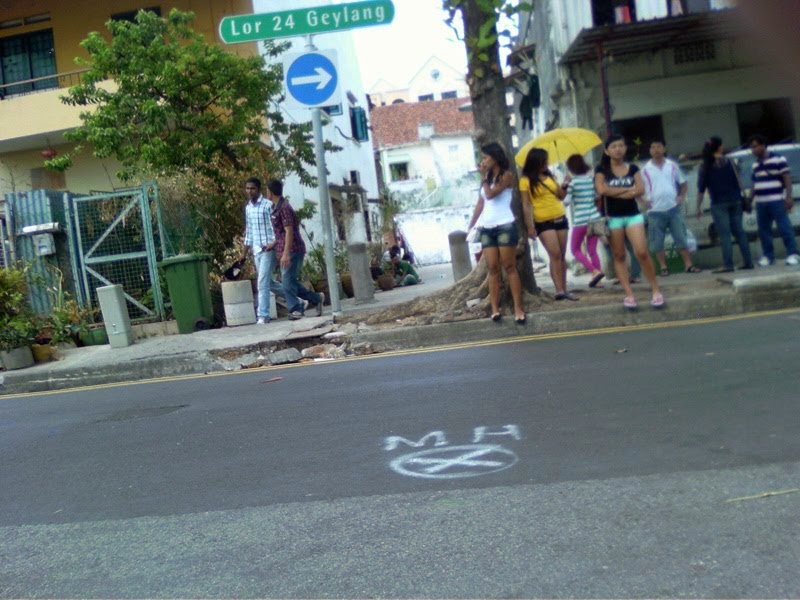


 read more
Helping Elderly Cardboard Collectors in Singapore
Have you ever Spoken to a Cardboard Uncle or Aunty?
Hazards being a Cardboard Picker
Collecting Cardboards "form of exercise" & "protecting our environment"
When Cardboard Is Gold
Buskers, Tissue Paper Peddlers, & Street Walkers
Karung Guni: The Rag and Bone Men
'Tissue and Cardboard' Sellers
Plight Of The Tissue Peddlers
Singapore’s Elderly Poor
Golden Year For The Elderlies
Support for the Needy and Elderly
Elderly in Singapore need S$1,379 a month
1,000 street homeless found in Singapore
The Surprising Truth About The Homeless In Singapore
The Poor & Homeless in Singapore
Tent Village: Singapore’s nomad families
Sex in the city drags you down
Women, Sex and Singapore
An Undercurrent Of Fear In Geylang
Regular train delays.
Overcrowded trains.
And LTA thinks we need Buskers.
Buskers, themed cabins for a better MRT experience
Buskers performing at train platforms, elaborately-decorated themed carriages and staff clutching stuffed toy flowers and giving out tissues to welcome commuters — these are among the “social experiments” the Land Transport Authority (LTA) is embarking on over the next few months to make commuters’ train journeys a little less harried.
Efforts are already under way to upgrade ageing train infrastructure and improve service quality, but these projects will take years to bear fruit. For example, new trains will only arrive from this year, while the sleeper replacement project will be completed by 2016.
In the meantime, the LTA hopes these social initiatives can make commuters’ journeys more palatable and encourage people to smile.
LTA to allow buskers to perform at MRT platforms
A football-themed cabin on the North-South Line with turf grass and stickers directing commuters to the middle of the cabin. Photos: LTA
LTA has announced that it will be introducing new social initiatives to make commuters’ journeys more palatable and encourage commuters to smile.
Some of the new initiatives which LTA will be trying out in the next few months include:
- Buskers performing at train platforms
- Elaborately-decorated themed carriages
- Staff clutching stuffed toy or flowers and giving out tissues to welcome commuters
Efforts are already under way to upgrade ageing train infrastructure and improve service quality, but these projects will take years to bear fruit. In the meantime, LTA hopes that its social initiatives will help make commuters’ train journeys “a little less harried”.
Commuters Are Not Entertained
When you have civil servants paid from $300,000 onwards, it's inevitable they miss the disconnect. Instead of looking for ways and means to cut costs and reduce public transportation charges, they are forever cooking up ideas to splurge to the hilt. Any financial relief is welcome now, in the wake of the Medishield Life premium hikes.
Do we really need entertainment videos at train stations when the jam packed coaches afford only views of the smelly armpit of another unhappy commuter, 1 of 3 which is likely to be non-Singaporean? They had a failed attempt once installing mobile video on buses, at an undisclosed cost which was probably passed on to the passengers. When that system was canned, and video service terminated, no fare reduction materialised.
The "heritage videos" they are planning to showcase at station platforms won't be coming in cheap. Keep the propaganda videos and offer fare rebates instead. Commuters would rather have a shorter wait for a ride than hanging around the station for the 5 or 10 minute "content which is meaningful, informational and entertaining."
What is SMRT thinking?
Commuters and the public are not amused by the latest SMRT initiatives to make commuting more relax and fun. SMRT is going to encourage buskers in the stations, paint the trains according to themes of the day, like football season and more. These frivolous things cost money and will eventually be passed to the commuters.
What is making the commuters and public seeing red is the obvious disconnect in the thinking of the SMRT management and the needs of the commuters. The commuters are not asking for the sky or pole dancing in the train cabins. All they are asking for are smooth, fast, clean, not smelly and less jam packed trains. Are these too difficult to understand?
The frills that the SMRT are planning to roll out are an astounding piece of ‘out of touch’ work, totally oblivious of their mission and the needs of the commuters. Who could come out with such ideas, some foreign talents or someone living in the ivory tower?
Buskers, colourful stickers, free tissue to distract MRT commuters from overcrowded conditions during peak hour
Buskers performing at train platforms. Train carriages plastered with bright stickers. Free tissue paper for commuters.
Are these God’s greatest gifts to mankind since salted egg custard bun and this gif of Emma Watson doing this?:
Not really, because these are just some of the initiatives the Land Transport Authority (LTA) will be implementing over the next few months to make the train journeys of MRT-riding commuters more tolerable, as reported by Today on June 30, 2014.
Next Stop: Buskers and Stickers
When I first left Singapore nearly 3 years ago, I would feel really pissed off reading about such things. Today, I could only let out a sigh as a cloud of sadness engulfed me. Regardless what the others think, my passport is red and I'm still as Singaporean as before I left. Perhaps having the privilege of living in a different country has allowed me to watch the proceedings in Singapore from afar, giving me broader perspective. I'm grateful for that but at the same time this can be such a painful experience.
I have wrote several times about LTA's tendency to splurge on meaningless items such as premium covered linkways, designer MRT lift shelters and their obsession with demolishing perfectly usable bus stops. So it isn't surprising for me that LTA is preparing to spend millions of taxpayers' money again on their newest initiative.
Like every "blue collared" trade, it is well respected in Australia and many parts of the world. In Singapore, these professions are regarded as something the cat drags in. Many buskers in Singapore are cleverly disguised licensed beggars in a bid to keep Singapore streets 'beggar-free' because somebody famous once challenged the press to show him where are the beggars in Singapore. Poor beggars in Singapore have to quickly equip themselves props and instruments and with their most convenient skills, actually talented or not, pay for a license to erm.. busk. I believe the man who coined the lovely terms such as "Cheaper, better, fastest" and "Upturn the downturn" will be able to come out with a delightful tagline to describe this amazing beggar-busker conversion magic.
Theme SMRT cabins for what better experience?
Talk about visual noise. I still remember the horrendous Dim Sum Dollies jingle. Why not just keep it simple, LTA, and focus on the service of actually bringing people from one place to another?
So unless your themed cabin is some incredible idea, please, don't.
You know every time I want to look at how minutes there are to the next train coming, and I see an ad of some movie trailer? Do you think that makes my journeys more or less harried?
LTA’s experiments to “encourage people to smile” while commuting
The Land Transport Authority (LTA) wants to make your journey on public transport “a little less harried.”
So it is introducing buskers performing at train platforms, and elaborately-decorated themed carriages.
Also, don’t be surprised to see “staff clutching stuffed toy flowers and giving out tissues to welcome commuters.”
Also, don’t be surprised to see “staff clutching stuffed toy flowers and giving out tissues to welcome commuters.”
Allowing rise in illegal busking and tissue peddling is like condoning begging
Please step up the enforcement to curb illegal buskers and tissue sellers, says STOMPer David, who spotted two illegal buskers at Raffles Place, and Ang Mo Kio MRT. He even saw an old lady and another man selling tissue illegally and feels that this practice condones begging.The STOMPer recounts his three different incidents:"
On Jan 12 at Clifford Centre outside Raffles Place MRT, I spotted a busker playing banjo to collect public money by taking advantage of the crowd and passers-by during lunch-time from 12pm to 2pm. "He was spotted last week at Market Street in front of Republic Plaza 2 outside traffic-lights junction too. "According to NAC licence rules and regulations, Buskers with a license are allowed to perform at the specific location posted to them stated on their licenses. "Raffles Places Place and Market Street is not the specific location for buskers to perform. So I called 999 to get the Police to take actions against this busker." After the Police officers read my email, they contacted NAC to confirm them before advising the busker to move away." On Jan 13 at traffic-lights junction of Phillip Street and Church Street near a temple. "I spotted illegal buskers playing guitar and singing songs with amplifier to collect public money by taking advantage of the crowd and, passers-by during lunch time from 12pm to 2pm. "What kind of action will the Police take if they were to return again?" Collecting public money without a license is also consider begging."
On Jan 6, I spotted another illegal busker and tissue seller at Ang Mo Kio MRT underpass and Ang Mo Kio Avenue 8 near Block 703 walkway area behind Ang Mok Kio Hub almost every day." They will be there to collect public money by taking advantage of the crowd from the evening rush hours from 4pm to 7pm." Especially the lady in wheelchair. She's stubborn and aggressive and can still argue with the NEA officers and Cisco officers that she has the right to sell tissue paper when her licence only states that she can sell at Aljunied Town Council." According to NEA rules and regulations, only newspapers are allowed to be sold at MRT stations and underpass. Tissue papers are only allowed to be sold at specific location posted to them in their licences." I called 999 to get the Police officers to take actions against the illegal busker."There are two more of these tissue sellers in wheelchairs, a fat man and an old woman too." Please step-up enforcement in these areas until all are clear away." Illegal buskers and tissue sellers are on the rise at outside MRT Stations and MRT Underpass also at hawkers, centres."
related: This talented old busker is a one-man band
read more
Arts review committee suggests relaxation of busking rules
Singapore street buskers have been entertaining the public since 1997, after a three—year ban was lifted.
A committee to review the arts and culture landscape recently suggested relaxing the rules to add more spice to the busking scene.
Busker Lee Kui Lim, who performs twice a week, said that the real challenge is not catching the audience’s attention, but rather getting them to give money.
related:
A GOOD busker with a BIG heart!Basking At Orchard Road Singapore
Daniel Deserves The Esplanade Stage To Perform
read more
Tissue paper peddlers are unlicensed hawkers, says NEA
Mobile peddlers selling packets of tissue paper on the streets are unlicensed hawkers, said the National Environment Agency (NEA) in response to a letter posted on a website that these peddlers are charged a S$120 licence fee.
“Although technically in breach of the laws against itinerant hawking, those peddlers who are needy are referred to the relevant agencies by the NEA for appropriate assistance,” the agency said on its Facebook page on Tuesday.
In a letter posted on the socio-political website The Real Singapore, the writer had questioned the need for street hawkers to pay S$120 to get a licence following his encounter with a visually-impaired man who sells tissue paper for extra income.
NEA will take action against unlicensed tissue paper peddlers
“Although technically in breach of the laws against itinerant hawking, those peddlers who are needy are referred to the relevant agencies by NEA for appropriate assistance,” said the National Environment Agency (NEA).
The agency was asked for its views following a report in the website, The Real Singapore, which highlighted that the authorities impose a S$120 annual licence fees for tissue peddlers.
The article, which apparently was submitted by a member of the public, said that the writer had an encounter with two visually impaired men. One of the men told him that he was selling tissue paper “to supplement his income as he cannot find a regular job.”
TISSUE PAPER UNCLE
There’s a tissue paper uncle at the hawker centre nearby who I regularly buy tissue from. He used to sell them in bunches of four with a rubber band tied around them, and he used to write four numbers on each bunch - if you were interested in getting lucky with them. At the time I thought this was a clever idea - you can see some effort being put into the ‘work’ he was doing.
He doesn’t do this anymore. It’s now the regular tissue packets, no quirky details.
Last night, as I bent down to get tissue from him there was a man telling him, “Uncle, don’t do stupid things, uncle. Cannot.” I passed him the $2 and took one packet for myself and walked away slowly. Clif and I looked back and saw that he motioned slitting his wrists and realised what the guy meant.
related: Asian Buzz - Tissue Paper Uncle
read more
TISSUE PAPER UNCLE - Part 2
These tissue paper sellers are fiercely independent. They work because they do not want to be a burden to the society.
We should respect that and two, how we can proceed from here..is to give them a little respect, offer your couple of dollars and thank them for their service. Finally, there are always people out there who need help.
How that help looks like could be just a listening ear or more. We’ll just need to listen first to figure it out.
read more
People pay more to buy from him, but tissue uncle
STOMPer Giver feels that it's not right for this elderly man, who sells tissue paper at a higher price to customers, to be spending his money on beer.
Said the STOMPer: "I was having a drink at a hawker centre in Bugis when I saw a tissue uncle sitting on the next table taking a break. "He was re-packing the tissue from the big bag into small packets for sale. "Most people buy from them, at a high mark-up price, because of charity or pity. "But this uncle seems to give the wrong impression by having a drink of stout. "I'm not saying he can't but please why do it so openly.
"Many people were staring at him but he don't seem to care. I now have doubts on how real these people are."
The lady with amazing voice, selling tissue paper
This lady with amazing voice use to visit my neighbourhood, selling tissue paper. I won’t call her the Tissue paper lady, but rather, the lady with the voice, selling tissue paper. She has been plying her trade for almost a decade.
However unlike many other disadvantaged Singaporeans, she sings for her sale, rather than just selling them. She was made famous by Tan Pin Pin’s 2005 documentary, “Singapore Ga Ga”. Check out the documentary, a great piece on Singapore.
Whenever she is around, she really brightens my day with her beautiful singing, making it a rather colorful neighbourhood rather than a static and stagnant one. Thank you, I do hope to see you again.
read more
THE 'PROMOTERS' - They haggle over price in front of camera
It did not bother them that the backlane was brightly-lit. They also didn't mind that a surveillance camera was pointed in their direction from about 10m away.
With brazen disregard, the 10 streetwalkers, dressed in tank tops and hot pants, or tight dresses to accentuate their figures, went about their trade.
Near them were three foreign men whose job was to promote their range of sexual services.
People in Geylang speak of undercurrent of fear
Streetwalkers standing along the junction of Geylang Road and Geylang Lorong 22 last Thursday. Donning skimpy outfits, they emerge at dusk like clockwork and flirt with men, both foreign and local. -- ST PHOTOS: DESMOND WEE
At dusk, like clockwork, streetwalkers in skimpy outfits emerge from alleyways. They flirt with men, both foreign and local, while being watched by minders on the alert for the police.
Off-corner massage parlours and hotels with hourly rates do a roaring trade. Nearby, peddlers sell sex drugs with names such as Super Magic and Tiger's Prestigious Life, while others deal in contraband cigarettes.
This is Geylang, Singapore's notorious red-light district and another foreign worker hot spot now in the spotlight after Police Commissioner Ng Joo Hee said last week that the area was a bigger concern than Little India, where last December's riot took place.
A midnight stroll through Geylang can be a surreal experience
Freelancer sex workers, believed to be Thai, standing by outside Westerhout Road
Go after the heavens have opened and the rain-slicked pavements become kaleidoscopes of colour as they reflect the areas' ubiquitous neon. On any given night, the notorious red-light district has more colours on show, giving the area an almost alien aura. The oddities don't stop there.
The always busy Geylang Road is possibly the only place on this island where you can experience bumper-to-bumper traffic at 1am. Perhaps the drivers are distracted by the garish lights, screaming for attention from the sex shops and budget hotels.
"But as my husband said, the best food in Singapore is always located in the weirdest places!"
read more
Neighbours move out, pimps move in
How often have you heard that for property, it's all down to location, location, location? Jalan Suka, by all accounts, is ideally located.
It's about a five-minute walk to the MRT stations, a 10-minute drive into the city and with good food all day, all night.
But there's a catch - it's in Geylang. Until about 10 years ago, streetwalkers limited their trade to Lorongs 18, 16 and 14. That's a five-minute walk away.
read more
GEYLANG HAS MANY MORE SERIOUS CRIMES THAN LITTLE INDIA
At the Committee of Inquiry into the Little India Riot, Commissioner of Police Ng Joo Hee said that Singapore should focus more on Geylang rather than Little India for crime prevention
While everyone is worried about Little India at the moment because of the riot which occurred there in December, he pointed out that there is much more lawlessness in Geylang.
He described Geylang as having a "complex and complicated" character with a "definite criminal undertone".
Ng pointed out that there is also a distinct anti-police sentiment in Geylang with vandalism of police vehicles and obstruction of police duties occurring fairly frequently.
related: WE NEED ANOTHER 1,000 POLICE OFFICERS?
read more
Women at Geylang coffeeshop sit on uncles' laps and give them free kisses to get them to buy lottery tickets
A group of women in their twenties and thirties prowl a coffeeshop in Lorong 23 Geylang daily, in search of middle-aged men who will buy lottery tickets from them with a bit of persuasion.
According to Shin Min Daily News, the young women, who are reportedly from Vietnam, bat their eyelid, sit on the uncles' laps and give them free kisses to make them buy.
These uncles, however, do not need much persuasion.
Is it legal to resell lottery tickets?
A group of about 20 Vietnamese women are using their charms to re-sell lottery and 4-D tickets in Geylang, Shin Min Daily News reported.
The women, in their 20s and 30s, flirt with men in a coffee shop in Geylang Lorong 23 and sometimes kiss the men. Some even go as far as sitting on the laps of their customers, who are mostly elderly men, the Chinese daily reported.
The men's hands would stray, but the women did not seem to mind.
Men charmed into buying lottery tickets
A GROUP of about 20 Vietnamese women are using their charms to re-sell lottery and 4-D tickets in Geylang, Shin Min Daily News reported.
The women, in their 20s and 30s, flirt with men in a coffee shop in Geylang Lorong 23 and sometimes kiss the men.
Some even go as far as sitting on the laps of their customers, who are mostly elderly men, the Chinese daily reported.
related: Men charmed into buying lottery tickets
read more
Coffee, tea or massage?
Welcome to mobile massage, Geylang style. The New Paper learnt of the trend and visited a coffee shop along Geylang Lorong 11 two Mondays ago at about 9pm. We spotted three women, who looked to be in their 30s to 40s, busy kneading tired knots out of their topless male clients.
Fifteen to 30 minutes later, the sessions ended and the women moved on to the next table, looking for new clients. They also appeared organised, spacing themselves about 10 tables apart as they went about their business.
Although the men receiving the massage may welcome the service, some residents in the area are not happy with the public offering. A TNP reader said that such public massages first appeared about three months ago.
Morning / afternoon can find streetwalker in Geylang or not?
Have you ever Spoken to a Cardboard Uncle or Aunty?
Hazards being a Cardboard Picker
Collecting Cardboards "form of exercise" & "protecting our environment"
When Cardboard Is Gold
Buskers, Tissue Paper Peddlers, & Street Walkers
Karung Guni: The Rag and Bone Men
'Tissue and Cardboard' Sellers
Plight Of The Tissue Peddlers
Singapore’s Elderly Poor
Golden Year For The Elderlies
Support for the Needy and Elderly
Elderly in Singapore need S$1,379 a month
1,000 street homeless found in Singapore
The Surprising Truth About The Homeless In Singapore
The Poor & Homeless in Singapore
Tent Village: Singapore’s nomad families
Singapore: Best Place to Live and Work
Singapore’s Story: What comes next
Singapore at 50: From swamp to skyscrapers
Singapore Good Old Times
The Singapore Story
Other Side of The Singapore Story
ChasingThe Singapore Dream
To Be Or Not To Be Singaporeans
Longing for the good old days
Singapore: A Sampan or a Cruise ship?
Singapore at 50: From swamp to skyscrapers
Singapore is ‘World’s Costliest City To Live In’
Coping with Inflation & Cost Of Living
COL goes Up, Up, Up!
Singapore “Swiss” Standard of Living
Tackling poverty the 'kuih lapis' way
Callings for a Poverty Line
Setting a poverty line may not be helpful
A minimum wage for Singapore?
No homeless,destitute starving people in S'pore:Poverty eradicated
Growing Up With Less
Where sleaze and food coexistSingapore’s Story: What comes next
Singapore at 50: From swamp to skyscrapers
Singapore Good Old Times
The Singapore Story
Other Side of The Singapore Story
ChasingThe Singapore Dream
To Be Or Not To Be Singaporeans
Longing for the good old days
Singapore: A Sampan or a Cruise ship?
Singapore at 50: From swamp to skyscrapers
Singapore is ‘World’s Costliest City To Live In’
Coping with Inflation & Cost Of Living
COL goes Up, Up, Up!
Singapore “Swiss” Standard of Living
Tackling poverty the 'kuih lapis' way
Callings for a Poverty Line
Setting a poverty line may not be helpful
A minimum wage for Singapore?
No homeless,destitute starving people in S'pore:Poverty eradicated
Growing Up With Less
Sex in the city drags you down
Women, Sex and Singapore
An Undercurrent Of Fear In Geylang


