
Update 26 Jul 2022: China launches Wentian module to Tiangong space station

China's first lab module for space station
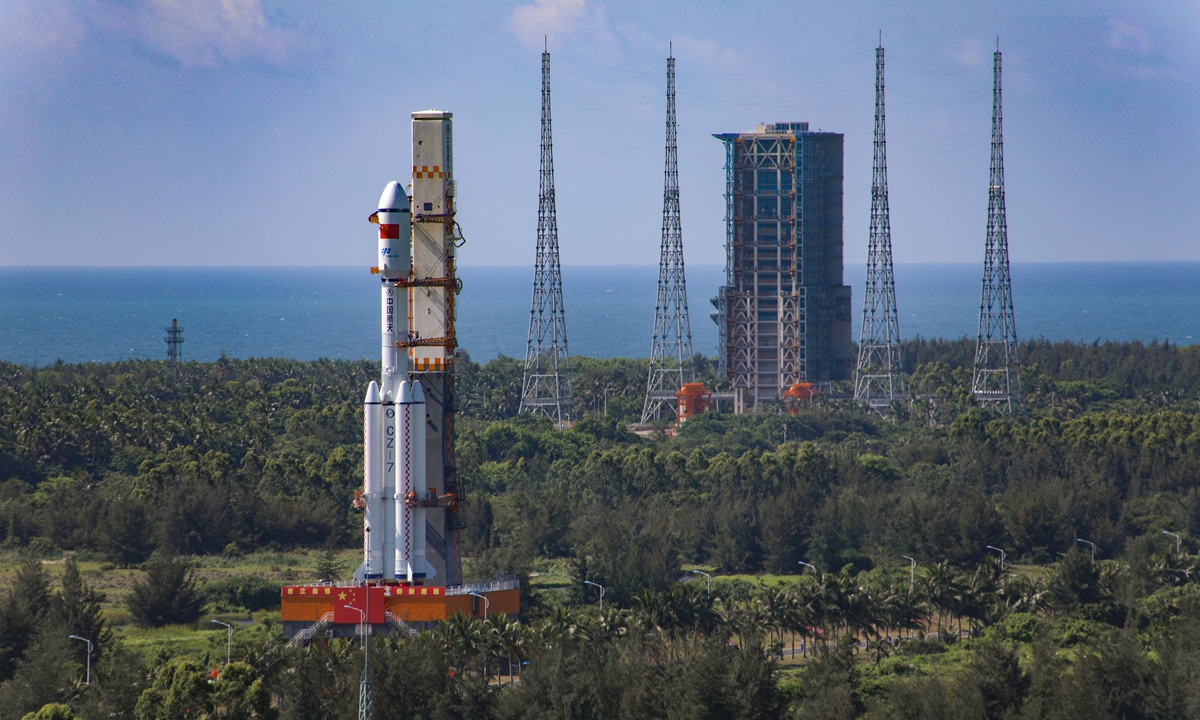
China on Sunday launched Wentian, the first lab module of its space station. The new module will function both as a backup of the core module and as a powerful scientific experiment platform. The Wentian module is 17.9 meters long, has a maximum diameter of 4.2 meters and a takeoff mass of 23 tonnes, almost the size of a subway car in Beijing. It is the heaviest single-cabin active spacecraft in orbit in the world, according to Liu Gang, deputy chief designer of the China manned space program's space station system with the China Academy of Space Technology (CAST).
The Wentian module consists of a work cabin, an airlock cabin and a resource cabin. The Long March-5B Y3 carrier rocket, carrying Wentian, blasted off from the Wenchang Spacecraft Launch Site on the coast of the southern island province of Hainan at 2:22 p.m. (Beijing Time), according to the China Manned Space Agency (CMSA). About 495 seconds later, Wentian separated from the rocket and entered the planned orbit. The launch is a complete success, the CMSA declared.
This is the 24th flight mission since the country's manned space program was approved and initiated. The construction of China's Tiangong space station is expected to be completed this year. It will then evolve from a single-module structure into a national space laboratory with three modules -- the core module Tianhe, and lab modules Wentian and Mengtian. The Tianhe module was launched in April 2021, and the Mengtian module is set to be launched in October this year.
3 Chinese astronauts arrive at Tiangong space station for 6-month stay

The Shenzhou 14 mission docked to China's Tianhe space station module on June 5, 2022. (Image credit: CMSA)
During their time in orbit, the trio will conduct a variety of scientific experiments and educational outreach activities, perform several spacewalks and install some new equipment inside and outside Tianhe, Chinese space officials have said. The astronauts will also oversee the arrival of Tiangong's other two modules, Wentian ("Quest for the Heavens") and Mengtian ("Dreaming of the Heavens"), which are scheduled to launch in July and October, respectively. Wentian and Mengtian will attach on either side of Tianhe, forming a T-shaped orbiting outpost about 20% as massive as the International Space Station (ISS).
The two previous crewed missions to Tianhe, Shenzhou 12 and Shenzhou 13, also sent three astronauts to the core module. Shenzhou 12 launched in June 2021 and lasted for three months, and the six-month-long Shenzhou 13 launched in October and returned to Earth in mid-April. Shenzhou 15 is expected to launch around the end of the year. (It's tough to know for sure; China tends not to reveal many details about its space missions until they're just about to happen.) If all goes according to plan, Shenzhou 15 will overlap with Shenzhou 14, marking the Tiangong space station's first-ever crew handover.
Shenzhou-14 astronauts enter space station core module

On June 5, China launched the crewed spaceship Shenzhou-14, sending astronauts Chen Dong, Liu Yang and Cai Xuzhe to its space station combination for a six-month mission. The trio will cooperate with the ground team to complete the assembly and construction of China's space station, developing it from a single-module structure into a national space laboratory with three modules.
The three Shenzhou-14 astronauts successfully entered the Tianzhou-4 cargo craft at 12:19 p.m. BJT on Monday, the China Manned Space Agency (CMSA) announced. The trio was sent to China's space station on June 5. China's cargo spacecraft Tianzhou-4, with supplies for the Shenzhou-14 crewed mission, docked with the combination of the space station core module Tianhe and the Tianzhou-3 cargo craft in May.
China's manned spacecraft Shenzhou-14 was successfully launched into orbit from Jiuquan Satellite Launch Center on Sunday morning. Three taikonauts, Chen Dong, Liu Yang and Cai Xuzhe, will stay in orbit for six months and help complete the construction of China's space station by the end of this year.
Three Chinese astronauts arrive at space station

Chinese astronauts Cai Xuzhe (L to R), Chen Dong and Liu Yang take part in a ceremony prior to the launch of the Shenzhou-14 mission (Photo: AFP/STR)
Three Chinese astronauts arrived at the country's space station on Sunday (Jun 5), the Chinese space agency for human flights said, the latest stride in Beijing's aim to become a major space power. The trio blasted off in a Long March-2F rocket at 2.44am GMT (10.44am Singapore time) from the Jiuquan launch centre in north-western China's Gobi desert, reported state broadcaster CCTV.
The team is tasked with "completing in-orbit assembly and construction of the space station", as well as "commissioning of equipment" and conducting scientific experiments, state-run CGTN said on Saturday. The astronauts entered the central module of the Tiangong station at around 12.50pm GMT (8.50pm Singapore time), the China Manned Space Agency (CMSA) said. The journey took about "seven hours of flight", CCTV reported.
Tiangong, which means "heavenly palace", is expected to become fully operational by the end of the year. China's heavily promoted space programme has already seen the nation land a rover on Mars and send probes to the Moon.
'Mystery hut' on the moon just the latest weird lunar find by China's Yutu 2 rover

China’s Yutu 2 rover has spotted a mystery object on the horizon while working its way across Von Kármán crater on the far side of the moon.
Yutu 2 spotted a cube-shaped object on the horizon to the north and roughly 260 feet (80 meters) away in November during the mission's 36th lunar day, according to a Yutu 2 diary published by Our Space, a Chinese language science outreach channel affiliated with the China National Space Administration (CNSA). Our Space referred to the object as a "mystery hut" (神秘小屋/shenmi xiaowu), but this a placeholder name rather than an accurate description.
Team scientists have expressed a strong interest in the object and Yutu 2 is now expected to spend the next 2-3 lunar days (2-3 Earth months) traversing lunar regolith and avoiding craters to get a closer look, so updates can be expected.
Chinese astronauts return after 90-day mission to space station

Three Chinese astronauts returned to earth on Friday after a 90-day visit to an unfinished space station in the country's first crewed mission since 2016. In a small return capsule, the three men - Nie Haisheng, Liu Boming and Tang Hongbo - landed safely in the autonomous region of Inner Mongolia in the north of China at 1:34 p.m. (0534 GMT), state media reported.
The Shenzhou-12 mission was the first of four crewed missions planned for 2021-2022 as China assembles its first permanent space station. The process requires 11 missions, including the launches of the station's three modules.
Construction kicked off in April with the launch of the Tianhe module, the future living quarters of the space station. Slightly larger than a city bus, Tianhe was where Nie, Liu and Tang have stayed since mid-June, marking China's longest spaceflight mission. While in orbit, the astronauts conducted spacewalks, validated Tianhe's life-support system, tested the module's robotic arm, and sorted supplies for upcoming crewed missions.
Mission accomplished: China’s Shenzhou-12 crew safely back on earth

The three taikonauts, mission commander Nie Haisheng(center), Liu Boming(right) and Tang Hongbo, emerged from the Shenzhou-12 return capsule on Friday, all in good health, drawing a perfect conclusion to the mission. Photo: Xinhua
Having extended the record of Chinese astronauts' longest stay in space in a single flight mission to 90 days, the Shenzhou-12 mission crew returned to Earth days before China's Mid-Autumn Festival - the day of family reunion and friend gatherings - at the designated Dongfeng landing site in the Gobi Desert, North China's Inner Mongolia Autonomous Region on Friday, marking a successful conclusion of the first crewed mission at the country's space station building stage.
The Shenzhou-12 return module separated from the orbiting module at 12:43 pm on Friday, and was then followed by a smooth separation from the propellant, according to the China Manned Space Agency (CMSA). Carrying the three taikonauts - mission commander Nie Haisheng, and his fellow crew members Liu Boming and Tang Hongbo - the return capsule touched down at the landing site as of 1:34 pm.
The homecoming heroes did not have to wait too long before the search and rescue squad with the Dongfeng landing site reached them only five minutes after the return capsule made its landing on Earth, which showed China's advanced, mature rescue capabilities, and highlighted China's priority in putting taikonauts' safety always in the first place. They were soon confirmed in good physical and mental conditions.
Shenzhou-12 crew dock with Tiangong Space Station


China sends 3 astronauts on space mission

Beijing is launching a manned mission on June 17, 2021 to continue construction on China’s first space station.
The Long March 2F rocket will carry the three-man crew, who will be stationed for three months at Tianhe, the core module of China’s Tiangong Space Station.
The Shenzhou-12 is the third of 11 missions to construct China’s space station, which is expected to be ready by 2022.
The significance of China's new space station

In this Nov. 7, 2018, photo, visitors look at a life-size model of the Tianhe core module of China’s next space station at the Airshow China in Zhuhai in southern China’s Guangdong Province. China on Thursday, June 17, 2021 has launched its first crewed space mission in five years, sending three astronauts to a new space station that marks a milestone in the country’s ambitious space program. (Chinatopix via AP) (Uncredited/CHINATOPIX)
Adding a crew to China’s new orbiting space station is another major advance for the burgeoning space power.
Here’s a look at key developments:
- WHAT’S THE MISSION’S PURPOSE?
- WHY IS CHINA BUILDING THE STATION?
- POLITICS AND SECURITY
- WHO ARE THE ASTRONAUTS?
- WHAT ELSE IS CHINA DOING IN SPACE?
China willing to expand intl cooperation in space station, joint flight

China plans to complete the construction of its space station by the end of 2022. /CFP
China will expand international cooperation through its space station, including scientific projects and joint flights with foreign astronauts, Ji Qiming, assistant to the director of China Manned Space Engineering Office, said at Wednesday's press conference on the launch of Shenzhou-12 manned spacecraft.
Outer space is the commonwealth of people all over the world, and the exploration of the universe is the shared cause of mankind, said Ji. "Consistent with the principles of peaceful use, equality and mutual benefit, and common development, China's manned space mission is willing to carry out international cooperation and exchanges with countries and regions worldwide that are committed to the peaceful use of outer space."
Since the implementation of the project, Ji said, extensive cooperation has been carried out with space agencies from other countries including Russia, Germany, France, Belgium and Italy, as well as international space organizations such as the United Nations Office for Outer Space Affairs and the European Space Agency, in spacecraft technology, space science experiments and astronaut selection and training.
China-Russia space cooperation highlights high level of political trust
When announcing the Shenzhou-12 manned spaceship to be launched on Thursday, the China Manned Space Agency on Wednesday mentioned that China has engaged in broad cooperation with countries including Russia.
Factors such as uncertainty over US foreign policy "are pushing Russia and China to expand space cooperation," said Danil Bochkov (Bochkov), an expert at the Russian International Affairs Council. What is the importance of China-Russia cooperation in space? What do China's efforts to explore the space guided by the idea of building community with a shared future for mankind mean for the international space industry?
Bochkov shard his insights with Global Times (GT) reporter Lu Yuanzhi.
China's Shenzhou 12 astronauts send back stunning images of Earth

A portion of South Africa, photographed by Shenzhou 12 astronaut Tang Hango in late August 2021. (Image credit: Tang Hangbo/China Manned Space Engineering Office)
The three astronauts, the first crewmembers to visit Tianhe, have been aboard the module since June 17. The crew have completed two extravehicular activities (EVAs), or spacewalks, and carried out a range of experiments, but China's human spaceflight agency has only recently released images taken by the astronauts.
A first batch of images taken by Tang Hongbo and released in August include views from space of the Gulf of Guinea, lights illuminating north Africa, the Ethiopian Highlands and Indian Ocean, as well as Tang's sleeping quarters. Shenzhou 12 commander Nie Haisheng also sent back images of Beijing at night and a section of the Pacific Ocean.
China's Tiangong space station

3D illustration of Tiangong, the Chinese space station, orbiting Earth, with Earth in the background. (Image credit: Getty Images)
Tiangong is a space station that the Chinese Manned Space Agency (CMSA) is building in low Earth orbit. In May 2021, China launched Tianhe, the first of the orbiting space station's three modules, and the country aims to finish building the station by the end of 2022. CMSA hopes to keep Tiangong inhabited continuously by three astronauts for at least a decade. The space station will host many experiments from both China and other countries. Tiangong, which means "Heavenly Palace," will consist of Tianhe, the main habitat for astronauts, and two modules dedicated to hosting experiments, Mengtian and Wentian, both of which are due to launch in 2022. Shenzhou spacecraft, launching from Jiuquan in the Gobi Desert, will send crews of three astronauts to the space station, while Tianzhou cargo spacecraft will launch from Wenchang on the Chinese island of Hainan to deliver supplies and fuel to the station.
Tiangong will be much smaller than the International Space Station (ISS), with only three modules compared with 16 modules on the ISS. Tiangong will also be lighter than the ISS, which weighs about 400 tons (450 metric tons) following the recent addition of Russia's Nauka module. The 54-foot-long (16.6 meter) Tianhe module launched with a docking hub that allows it to receive Shenzhou and Tianzhou spacecraft, as well as welcome the two later experiment modules. A large robotic arm will help position the Mengtian and Wentian modules and assist astronauts during spacewalks.
Tianhe is much larger than the Tiangong 1 and 2 test space labs China launched in the last decade and nearly three times heavier, at 24 tons (22 metric tons). The new Tiangong, visiting spacecraft and cargo spacecraft will expand the usable space for the astronauts; so much that they'll feel as though "they will be living in a villa," compared with how little space was available on previous Chinese space labs, Bai Linhou, deputy chief designer of the space station, told CCTV.
Shenzhou (spacecraft)

Shenzhou consists of three modules: a forward orbital module (轨道舱), a reentry module (返回舱) in the middle, and an aft service module (推进舱)
Shenzhou (Chinese: 神舟; pinyin: Shénzhōu, /ˈʃɛnˈdʒoʊ/; see § Etymology) is a spacecraft developed and operated by China to support its crewed spaceflight program, China Manned Space Program. Its design resembles the Russian Soyuz spacecraft, but it is larger in size. The first launch was on 19 November 1999 and the first crewed launch was on 15 October 2003. In March 2005, an asteroid was named 8256 Shenzhou in honour of the spacecraft.
The literal meaning of the native name 神舟 (p: Shénzhōu; /ˈʃɛnˈdʒoʊ/) is "the Divine vessel [on the Heavenly River]", to which Heavenly River (天河) means the Milky Way in Classical Chinese. 神舟 is a pun and neologism that plays on the poetic word referring to China, 神州, meaning Divine realm, which bears the same pronunciation. For further information, refer to Chinese theology, Chinese astronomy and names of China.
Shenzhou consists of three modules: a forward orbital module (轨道舱), a reentry module (返回舱) in the middle, and an aft service module (推进舱). This division is based on the principle of minimizing the amount of material to be returned to Earth. Anything placed in the orbital or service modules does not require heat shielding, increasing the space available in the spacecraft without increasing weight as much as it would if those modules were also able to withstand reentry. The Shenzhou spacecrafts are:
Tiangong space station

Rendering of Tiangong Space Station between October 2021 and March 2022, with Tianhe core module in the middle, Tianzhou-2 cargo spacecraft on the left, Tianzhou-3 cargo spacecraft on the right, and Shenzhou-13 crewed spacecraft at nadir
Tiangong (Chinese: 天宮; pinyin: Tiāngōng; lit. 'Palace in the Sky'), officially the Tiangong space station (Chinese: 天宫空间站), is a space station being constructed by China in low Earth orbit between 340 and 450 km (210 and 280 mi) above the surface. Being China's first long-term space station, it is the goal of the "Third Step" of the China Manned Space Program. Once completed, Tiangong will have a mass between 80 and 100 t (180,000 and 220,000 lb), roughly one-fifth the mass of the International Space Station and about the size of the decommissioned Russian Mir space station.
The construction of the station is based on the experience gained from its precursors, Tiangong-1 and Tiangong-2. The first module, the Tianhe ("Harmony of the Heavens") core module, was launched on 29 April 2021, followed by multiple crewed and uncrewed missions and two more modules to be launched in 2022. Chinese leaders have expressed the hope that the research conducted on the station will improve researchers' ability to conduct science experiments in space, beyond the duration and capacity offered by China's existing space laboratories.
According to CMSA, which operates the space station, the purpose and mission of Tiangong is listed as: Further development of spacecraft rendezvous technology; Breakthrough in key technologies such as permanent human operations in orbit, long-term autonomous spaceflight of the space station, regenerative life support technology, and autonomous cargo and fuel supply technology; Test of next-generation orbit transportation vehicles; Scientific and practical applications at large-scale in orbit; Development of technology that can aid future deep space exploration. In addition, private sector commercial activities being encouraged, according to the designer of China's human spaceflight program: “When our space station is completed and running, we will actively encourage the private sector to engage in space through various ways.” “We hope there will be competitive, cost-efficient commercial space players to participate in areas including space applications and space resource development.” Operations will be controlled from the Beijing Aerospace Flight Control Center in China. To guarantee the safety of astronauts on board, a Long March 2F with a Shenzhou spacecraft will always be on standby for an emergency rescue mission.
China's Space Station Will Be Open to Science from All UN Nations
3D illustration of Tiangong, the Chinese space station, orbiting Earth, with Earth in the background. (Image credit: Getty Images)
China is working with the United Nations to help arrange scientific experiments aboard that country's space station.
The United Nations Office for Outer Space Affairs (UNOOSA) and China's Manned Space Agency have invited applications from UN member states to conduct experiments on China's space station (CSS). In 2016, the two signed a memorandum of understanding to work together to develop the space capabilities of UN member states via opportunities to use the station, which China expects to be operational by 2022. [Gallery: Tiangong 1, China's First Space Laboratory]
The "announcement of opportunity" and application instructions for this initiative were released at a ceremony hosted by UNOOSA and the Permanent Mission of China to the United Nations and Other International Organizations in Vienna on Monday (May 28).
related: China's Tiangong space station
Rocket blasts off carrying first Chinese crew to new space station
Chinese rocket carrying first crew to new space station blasts off
China sends astronauts on space mission to build Tiangong Space Station
Chinese rocket with manned crew to blast off Thursday
Blast off: China launches first crewed mission to Tiangong space station
Shenzhou-12: Watch China launch astronauts to its space station
Shenzhou-12 to send three Chinese astronauts to build space station
China will launch three astronauts to its ISS rival space station
The new space race: Why China is on track to beat the US
'Divine vessel' launched successfully;3 astronauts to reach China's space station
China to send three astronauts to space, including its oldest
China set to launch first crew to new space station
China to launch manned Shenzhou-12 spacecraft on Thursday
Special coverage on Shenzhou-12 crewed mission to Chinese Space Station
Another major step in low Earth orbit
China-Russia space cooperation highlights high level of political trust
Rocket lifts off with first crew for Chinese space station
China to launch Shenzhou-12 manned spaceship on June 17
China launch 3 astronauts into orbit part of ambitious plan to complete space station
Watch China launch rocket in first crewed mission in 5 years
China launches first astronauts to its space station
China set to send three astronauts into space ahead of CPC centenary celebration
China Sends 3 Men Into Space
China launches crewed spacecraft Shenzhou-12 in historic mission
Spacewalking astronauts boosting station's solar power
Press conference on China's first manned space station mission
'Divine Vessel' rocket launches China's first human spaceflight since 2016
Shenzhou-12 & 3 crew members successfully launch to new Chinese space station
China launches first crew to live on new space station
Russia, once a space superpower, turns to China for missions
China launches crewed Shenzhou-12 mission to test its future space station
Meet the astronauts set to blast off on Chinese space station mission
The significance of China's new space station
Three crew set for Thursday launch of China’s Shenzhou-12
China launches manned mission to space: Veteran astronaut, treadmills
China successfully launches three astronauts to new space station
China Sends Up Three Astronauts to Help Build Its Space Station
Chinese Astronauts Lift Off in Mission to Staff Space Station
China launching first crew to its own space station on Thursday
Chinese astronauts bid farewell ahead of launch to new space station
China launching 3 taikonauts to new space station Wednesday
China launches three-man crew to new space station
China Launches Astronauts to Space Station: Live Updates and Stream
Watch astronauts install new space station solar arrays in a spacewalk today
First astronauts blast off for China’s new space station
China completes historic launch of 1st astronauts to stay on its new space station
Live coverage: China launches first crew to new space station
China To Send Its First Taikonauts To The New Chinese Space Station Tonight
China launches first crew to new Tianhe space station
China launches three astronauts towards new space station
China is launching three astronauts to new space station
Extravehicular astronauts boost station solar power
China sends 3 astronauts to new space station in first crewed mission for 5 yrs
Chinese rocket carrying three astronauts to new space station blastsoff
This photo shows how fast the ISS really is
China to launch high-stakes crewed mission to space today
China's New Space Station Is Set to Welcome Its First Crew
Watch astronauts give the International Space Station a power boost
China will launch 3 astronauts to space station tonight
China Set to Launch First Crew to Its New Space Station
China to launch first crew to new space station on Thursday
China’s Shenzhou-12 with three astronauts blasts into space
China to send first astronauts to its space station site
Spacesuit problems prevent astronauts from completing job
China launches first astronauts to new space station
China successfully launches mission sending astronauts to new space station
Spacesuit problems prevent astronauts from completing job
China unveils logo for upcoming crewed space mission
China launches 3 astronauts to new space station
China Launches Shenzhou 12 Manned Spacecraft to Its Orbital Station
China to send the first astronauts to its self-developed space station on Thursday
China is launching the first astronauts to its new space station
China launches 3-person crew to its new space station
First Manned Chinese Spaceship Launch in Five Years
China set to send inaugural crew to its new space station for three-month stay
Watch: China is beating the US in the new space race - here's why
China launches spacecraft carrying 1st crew for new space station
Three astronauts will be first to board new Chinese space station
China to send first astronauts to new space station on longest crewed mission
China to launch high-stakes crewed mission to space
China to launch astronauts to new space station tonight
China set to send first crew to new space station on June 17
China launches first crewed mission for space station construction
China ready to launch first crew to new space station




Chinese rocket carrying first crew to new space station blasts off
China sends astronauts on space mission to build Tiangong Space Station
Chinese rocket with manned crew to blast off Thursday
Blast off: China launches first crewed mission to Tiangong space station
Shenzhou-12: Watch China launch astronauts to its space station
Shenzhou-12 to send three Chinese astronauts to build space station
China will launch three astronauts to its ISS rival space station
The new space race: Why China is on track to beat the US
'Divine vessel' launched successfully;3 astronauts to reach China's space station
China to send three astronauts to space, including its oldest
China set to launch first crew to new space station
China to launch manned Shenzhou-12 spacecraft on Thursday
Special coverage on Shenzhou-12 crewed mission to Chinese Space Station
Another major step in low Earth orbit
China-Russia space cooperation highlights high level of political trust
Rocket lifts off with first crew for Chinese space station
China to launch Shenzhou-12 manned spaceship on June 17
China launch 3 astronauts into orbit part of ambitious plan to complete space station
Watch China launch rocket in first crewed mission in 5 years
China launches first astronauts to its space station
China set to send three astronauts into space ahead of CPC centenary celebration
China Sends 3 Men Into Space
China launches crewed spacecraft Shenzhou-12 in historic mission
Spacewalking astronauts boosting station's solar power
Press conference on China's first manned space station mission
'Divine Vessel' rocket launches China's first human spaceflight since 2016
Shenzhou-12 & 3 crew members successfully launch to new Chinese space station
China launches first crew to live on new space station
Russia, once a space superpower, turns to China for missions
China launches crewed Shenzhou-12 mission to test its future space station
Meet the astronauts set to blast off on Chinese space station mission
The significance of China's new space station
Three crew set for Thursday launch of China’s Shenzhou-12
China launches manned mission to space: Veteran astronaut, treadmills
China successfully launches three astronauts to new space station
China Sends Up Three Astronauts to Help Build Its Space Station
Chinese Astronauts Lift Off in Mission to Staff Space Station
China launching first crew to its own space station on Thursday
Chinese astronauts bid farewell ahead of launch to new space station
China launching 3 taikonauts to new space station Wednesday
China launches three-man crew to new space station
China Launches Astronauts to Space Station: Live Updates and Stream
Watch astronauts install new space station solar arrays in a spacewalk today
First astronauts blast off for China’s new space station
China completes historic launch of 1st astronauts to stay on its new space station
Live coverage: China launches first crew to new space station
China To Send Its First Taikonauts To The New Chinese Space Station Tonight
China launches first crew to new Tianhe space station
China launches three astronauts towards new space station
China is launching three astronauts to new space station
Extravehicular astronauts boost station solar power
China sends 3 astronauts to new space station in first crewed mission for 5 yrs
Chinese rocket carrying three astronauts to new space station blastsoff
This photo shows how fast the ISS really is
China to launch high-stakes crewed mission to space today
China's New Space Station Is Set to Welcome Its First Crew
Watch astronauts give the International Space Station a power boost
China will launch 3 astronauts to space station tonight
China Set to Launch First Crew to Its New Space Station
China to launch first crew to new space station on Thursday
China’s Shenzhou-12 with three astronauts blasts into space
China to send first astronauts to its space station site
Spacesuit problems prevent astronauts from completing job
China launches first astronauts to new space station
China successfully launches mission sending astronauts to new space station
Spacesuit problems prevent astronauts from completing job
China unveils logo for upcoming crewed space mission
China launches 3 astronauts to new space station
China Launches Shenzhou 12 Manned Spacecraft to Its Orbital Station
China to send the first astronauts to its self-developed space station on Thursday
China is launching the first astronauts to its new space station
China launches 3-person crew to its new space station
First Manned Chinese Spaceship Launch in Five Years
China set to send inaugural crew to its new space station for three-month stay
Watch: China is beating the US in the new space race - here's why
China launches spacecraft carrying 1st crew for new space station
Three astronauts will be first to board new Chinese space station
China to send first astronauts to new space station on longest crewed mission
China to launch high-stakes crewed mission to space
China to launch astronauts to new space station tonight
China set to send first crew to new space station on June 17
China launches first crewed mission for space station construction
China ready to launch first crew to new space station
China launches Tianhe module to Tiangong space station

Rendering of Tianhe core module with the robotic arm at docking position
Tianhe (Chinese: 天和; pinyin: Tiānhé; lit. 'Harmony of the Heavens'), officially the Tianhe core module (Chinese: 天和核心舱), is the first module to launch of the Tiangong space station. It was launched into orbit on 29 April 2021, as the first launch of the final phase of Tiangong program, part of the China Manned Space Program (Project 921).
Tianhe follows in the footsteps of Salyut, Skylab, Mir, International Space Station, Tiangong-1 and Tiangong-2 space stations. It is the first module of a third-generation Chinese modular space station. Other examples of modular station projects include the Soviet/Russian Mir, Russian OPSEK, and the International Space Station. Operations will be controlled from the Beijing Aerospace Flight Control Center.
In 2018, a fullscale mockup of Tianhe was publicly presented at China International Aviation & Aerospace Exhibition in Zhuhai. In October 2020, China selected 18 new astronauts ahead of the space station construction to participate in the country's space station project.
related:


